Lesson 9 お花見 Practice
Part 1: Choosing the grammar form
Q1
申し訳ありませんが、部長に( )、お答えできません。
Related grammar point 79 花が咲いてからでなければ
申し訳ありませんが、部長に(聞いてからでなければ)、お答えできません。
I'm very sorry, but I can't give you an answer unless I ask the manager first.
1聞くと言えば
聞くと言えば: Does not fit the sentence structure; 「と言えば」 is normally used to pick up a topic that has already been mentioned
2聞いているうちに
聞いているうちに: Grammar Point 81; does not fit the context (which requires a prerequisite condition)
3聞きかけで
聞きかけで: Grammar Point 85; does not fit the context
4聞いてからでなければ ✓
Correct. 聞いてからでなければ: 「〜てからでなければ」 (Grammar Point 79); "I can't answer unless I ask the manager first"
Q2
映画を見ている( )携帯電話が鳴って、あせった。
Related grammar point 84 仕事の最中に
映画を見ている(最中に)携帯電話が鳴って、あせった。
I was in the middle of watching a movie when my phone rang, and I panicked.
1おかげで
おかげで: Expresses a good result brought about by a favorable cause; does not fit the context
2べきで
べきで: Expresses obligation; does not fit the sentence structure
3最中に ✓
Correct. 最中に: 「〜最中に」 (Grammar Point 84); "in the middle of watching a movie"; something unexpected suddenly happened
4とおりに
とおりに: Means "as, in accordance with..."; does not fit the context
Q3
国( )休日が違うので、外国製のカレンダーを使うときは気をつけよう。
Related grammar point 83 人によってその楽しみ方はそれぞれだ
国(によって)休日が違うので、外国製のカレンダーを使うときは気をつけよう。
Holidays differ from country to country, so be careful when using a calendar made abroad.
1によって ✓
Correct. によって: 「〜によって」 (Grammar Point 83); "depending on the country," holidays differ as well
2にとって
にとって: Means "from the standpoint of..."; does not fit the context
3にたいして
にたいして: Expresses a target of an action or attitude; does not fit the context
4について
について: Means "about..."; does not fit the context
Q4
弟は( )ノートがたくさんあるのに、また新しいノートを買ってきた。
Related grammar point 85 やりかけの仕事
弟は(使いかけの)ノートがたくさんあるのに、また新しいノートを買ってきた。
My younger brother has many half-used notebooks, yet he bought a new one again.
1使い終わる
使い終わる: Means "finish using," which contradicts the context of having many notebooks that are not used up
2使いかけの ✓
Correct. 使いかけの: 「〜かけ」 (Grammar Point 85); "half-used notebooks"
3使うほどの
使うほどの: Expresses degree; does not fit the context
4使うかわりに
使うかわりに: Expresses substitution or compensation; does not fit the context
Q5
これは初心者( )書かれたパソコンの本です。
Related grammar point 82 花見客向けに
これは初心者(向けに)書かれたパソコンの本です。
This is a computer book written for beginners.
1にとって
にとって: Means "from the standpoint of..."; does not fit the sentence structure
2らしく
らしく: Means "in a way typical of..."; does not fit the context
3向けに ✓
Correct. 向けに: 「〜向け」 (Grammar Point 82); "written for beginners"
4を通じて
を通じて: Means "through..." or "throughout..."; does not fit the context
Q6
肉まん買ってきたよ。温かい( )どうぞ。
Related grammar point 81 花が残っているうちに
肉まん買ってきたよ。温かい(うちに)どうぞ。
I bought some meat buns. Have one while they're still hot.
1うちに ✓
Correct. うちに: 「〜うちに」 (Grammar Point 81); "while they are hot"
2ために
ために: Expresses purpose or reason; does not fit the context
3ように
ように: Expresses an example or a purpose; does not fit the context
4とおり
とおり: Means "as, in accordance with..."; does not fit the context
Q7
私は、見る人が最後まで( )ようなおもしろいドラマを作りたいと思っています。
Related grammar point 86 行かずにはいられなくなって
私は、見る人が最後まで(見ずにはいられない)ようなおもしろいドラマを作りたいと思っています。
I want to make an interesting TV drama that viewers can't help watching to the end.
1見るはずがない
見るはずがない: Means "there is no way they would watch"; contradicts the context (the speaker hopes it will be watched)
2見ずにはいられない ✓
Correct. 見ずにはいられない: 「〜ずにはいられない」 (Grammar Point 86); "can't help watching all the way through"
3見るほどではない
見るほどではない: Means "not to the extent of being worth watching"; does not fit the context
4見かけない
見かけない: Means "not seen, rarely seen"; does not fit the context
Part 2: Building sentences
Put the 4 options into slots 1–4 in order, then pick the one that lands in the ★ slot.
Q1
ほかの仕事をする前に、12★4ほうがいい。
Related grammar point 85 やりかけの仕事
ほかの仕事をする前に、1やりかけの2仕事を3★終わらせて4しまったほうがいい。
Order: 2 → 4 → 3 → 1 ★ = option 3
Before you start other work, it is best to finish the work you have left half-done.
How the sentence is built
First comes 「やりかけの」, then 「仕事を」; the ★ falls on 「終わらせて」, which follows 「仕事を」 (corresponding to Grammar Point 85, かけ), and 「しまった」 closes the phrase. Full sentence: ほかの仕事をする前に、 やりかけの 仕事を 終わらせて★ しまった ほうがいい。
Q2
学校で勉強した12★4おきましょう。
Related grammar point 81 花が残っているうちに
学校で勉強した1ことは2忘れない3★うちに4復習しておきましょう。
Order: 2 → 4 → 1 → 3 ★ = option 1
Review what you learned at school before you forget it.
How the sentence is built
First comes 「ことは」, then 「忘れない」; the ★ falls on 「うちに」, which follows 「忘れない」 (corresponding to Grammar Point 81, うちに), and 「復習して」 closes the phrase. Full sentence: 学校で勉強した ことは 忘れない うちに★ 復習して おきましょう。
Q3
日本で正月に食べる料理12★4があるそうだ。
Related grammar point 83 人によってその楽しみ方はそれぞれだ
日本で正月に食べる料理1は2地方3★によって4特色があるそうだ。
Order: 2 → 3 → 1 → 4 ★ = option 1
It is said that the dishes eaten at New Year in Japan have distinctive features depending on the region.
How the sentence is built
First comes 「は」, then 「地方」; the ★ falls on 「によって」, which follows 「地方」 (corresponding to Grammar Point 83, によって), and 「特色」 closes the phrase. Full sentence: 日本で正月に食べる料理 は 地方 によって★ 特色 があるそうだ。
Part 3: Grammar in a passage
Blank 1
Related grammar point 82 花見客向けに
1向けの ✓
Correct. 向けの: 「〜向け」 (Grammar Point 82); "movies and amusement parks for children"
2にとって
にとって: Means "from the standpoint of..."; does not fit the sentence structure
3といえば
といえば: Means "speaking of..."; does not fit the context
4かけの
かけの: Grammar Point 85; does not fit the context
Blank 2
1さらに
さらに: Means "furthermore"; does not fit the context
2それから
それから: Expresses sequence in time; does not fit the context
3そのかわり ✓
Correct. そのかわり: "Instead"; it contrasts with the preceding statement that he didn't take me to movies or amusement parks
4そのうえ
そのうえ: Means "moreover, in addition"; does not fit the context
Blank 3
1によって
によって: Means "depending on..."; does not fit the context
2にとって ✓
Correct. にとって: "For..."; "for me, who didn't even know the rules"
3のかわりに
のかわりに: Expresses substitution or compensation; does not fit the context
4に対して
に対して: Expresses a target of an action or attitude; does not fit the context
Blank 4
Related grammar point 84 仕事の最中に
1食べている最中に ✓
Correct. 食べている最中に: 「〜最中に」 (Grammar Point 84); "while in the middle of eating," our team's turn at bat began
2食べてからでなければ
食べてからでなければ: Grammar Point 79; does not fit the sentence structure
3食べてから
食べてから: Means "after eating"; but the following sentences describe having to put food down half-eaten, so I was still eating when our team's turn at bat began; it does not fit the context
4食べたばかりで
食べたばかりで: Expresses having just finished doing something; does not fit the context
Blank 5
Related grammar point 85 やりかけの仕事
1食べたとたん
食べたとたん: Means "the moment I ate"; does not fit the context
2食べようとして
食べようとして: Means "trying to eat"; does not fit the context
3食べるとおり
食べるとおり: Means "as one eats"; does not fit the context
4食べかけで ✓
Correct. 食べかけで: 「〜かけ」 (Grammar Point 85); "half-eaten" food can still be set aside
Blank 6
1で ✓
Correct. で: Expresses means or manner; 「大声で応援する」 = to cheer loudly
2に
に: Does not fit the sentence structure
3と
と: Does not fit the sentence structure
4を
を: Does not fit the sentence structure
Show the passage with answers and translation
When I was a child, my father never took me to children's movies or amusement parks. Instead, he often took me to the baseball stadium. For me, who didn't even know the rules, the fun of baseball was the food bought for me at the concession stand.
During games, whenever my father bought a beer for himself, he always bought something for me too. Occasionally, while I was still in the middle of eating, our team's turn at bat would begin and I would have to cheer. Other food could be set aside half-eaten, but ice cream was a problem. Because I ate it in a hurry, my head would ache sharply.
Now, as I cheer loudly with a beer in one hand, my son, who turned five this year, is next to me drinking juice. Don't worry, I won't buy you ice cream. But you love ice cream just like I did as a child, don't you?
Part 4: Listening
Listen first, then tap an option. The transcript and explanation appear after you answer.
Q1
Nothing is printed on the test paper: choose by listening alone.
女の人と男の人が話しています。女の人は男の人がどうすると思っていますか。
Transcript
F:え?また本買ってきたの?
M:うん。これ新しく出たんだ。おもしろそうだから。
F:読みかけのが何冊もあるのに。
M:これは絶対最後まで読むよ。
F:この前もそんなこと言ってたじゃない。また読み終わらないうちに、新しいのを買ってくるに決まってる。
F: Huh? You bought another book?
M: Yeah, this one just came out. It looks interesting.
F: Even though you have several books you're only halfway through.
M: I'll definitely read this one to the end.
F: You said the same thing last time. You'll surely end up buying a new one again before you finish this one.
問 女の人は男の人がどうすると思っていますか。
1買ってきた本を最後まで読むと思っている
2買ってきた本を最後まで読まないと思っている ✓
3読みかけの本を最後まで読むと思っている
4新しい本を買わないと思っている
What does the woman think the man will do?
The question is "What does the woman think the man will do?" The woman says 「この前もそんなこと言ってたじゃない。また読み終わらないうちに、新しいのを買ってくるに決まってる」 (Grammar Point 81, 「〜うちに」; "You said the same thing last time. You'll surely end up buying a new one again before you finish reading this"). This is her judgment based on the man's usual pattern: she thinks he will not finish the book he just bought. 1 「買ってきた本を最後まで読むと思っている」 is the opposite of the woman's judgment. 3 「読みかけの本を最後まで読むと思っている」 is wrong because what she says is that he won't finish the new book, not the books he left half-read earlier. 4 「新しい本を買わないと思っている」 contradicts the facts, since the man has already bought a new book. → 買ってきた本を最後まで読まないと思っている. The answer is 2.
Grammar in this question
〜うちに:(Grammar Point 81) 「読み終わらないうちに」 = before finishing reading (something happens).
Key vocabulary
読みかけ half-read; unfinished (reading)
Q2
Nothing is printed on the test paper: choose by listening alone.
女の人が部長と話しています。女の人は部長のところへ何を言いたくて来ましたか。
Transcript
F:部長、失礼します。
M:上田君、どうしたの?
F:あの、すみません、えーと…あさってしめ切りの書類の件なんですが…。
M:ああ、先週頼んだあれね。もうできた?
F:あ、いえ、その…このところ忙しくて、まだやりかけでして…。データを整理してからでなければ書けないんですが、実はあさって、出張が入ってしまいまして…。
M:君にとっては難しい書類じゃないだろう?出張は朝から?
F:いえ、あの、午後からなんですけど。
M:じゃあ、午前中に出しておいてくれればいいから。
F:は、はい、でも…。
M:じゃ、がんばって。期待しているよ。
F:はい…。
F: Manager, excuse me.
M: Ueda, what is it?
F: Um, I'm sorry, well... it's about the document that's due the day after tomorrow...
M: Oh, the one I asked you for last week. Is it done?
F: Ah, no, well... I've been busy lately, so I've only done half of it... I can't write it until I've organized the data, and actually, a business trip has come up for the day after tomorrow...
M: That document isn't difficult for you, is it? Is the business trip from the morning?
F: No, um, it's from the afternoon.
M: Then just submit it by the morning.
F: Y-yes, but...
M: Well, do your best. I'm counting on you.
F: Yes...
問 女の人は部長のところへ何を言いたくて来ましたか。
1書類ができたこと
2データを整理してから、書類を書くということ
3書類のしめ切りをのばしてほしいということ ✓
4あさって出張すること
What did the woman come to say to the manager?
The question is "What did the woman come to say to the manager?" In the conversation, the woman hesitantly mentions the document due 「あさって」 and says it is 「まだやりかけ」 (still half-done). On top of that, 「あさって、出張が入ってしまいまして」 (a business trip has come up the day after tomorrow). The implication is that she wants the manager to extend the deadline, but she is never able to say it outright. In the end, the manager cuts her off with 「じゃあ、午前中に出しておいてくれればいいから」 (Then submit it by the morning), and all she can say is 「は、はい、でも…」. 1 「書類ができたこと」 contradicts 「まだやりかけ」. 2 「データを整理してから、書類を書くということ」 is only her explanation of why her progress is slow, not the purpose of her visit. 4 「あさって出張すること」 is also only background information. → 書類のしめ切りをのばしてほしいということ. The answer is 3.
Grammar in this question
〜てからでなければ:(Grammar Point 79) 「整理してからでなければ書けない」 = I can't write it unless I organize the data first.
Key vocabulary
しめ切り deadline
Q1
この問題では、絵を見ながら質問を聞いてください。矢印(→)の人は何と言いますか。1から3の中から、最もよいものを一つえらんでください。
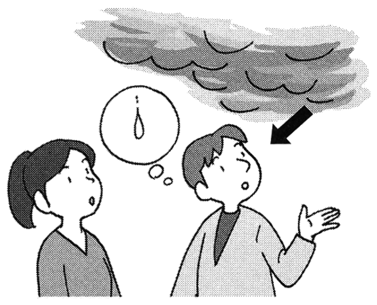
Listen to this sentence first
問 雨が降りそうです。何と言いますか。
It looks like it's going to rain. What do you say?
1雨が降ったら早く行こう。
If it rains, let's go quickly.
2雨が降っているから早く行こう。
It's raining, so let's go quickly.
3雨が降らないうちに早く行こう。 ✓
Let's go quickly before it rains.
In the picture, dark clouds fill the sky and two people look up at it. The man indicated by the arrow should tell his companion to hurry before it starts to rain. 雨が降らないうちに早く行こう uses 「〜うちに」 (Grammar Point 81), "before it rains," and exactly matches the situation in the picture: dark clouds, no rain yet, and rain about to fall, which is the "before a change occurs" situation. 1 「雨が降ったら早く行こう」 supposes "let's go once it has rained," which does not match the reasonable course of action of going while it is not yet raining. 2 「雨が降っているから早く行こう」 presupposes that it is already raining, which contradicts the picture, where it is only about to rain. The answer is 3.
Grammar in this question
〜うちに:(Grammar Point 81) Before a change occurs. 「降らないうちに」 = before it rains.