Lesson 10 ゆきの選択 Practice
Part 1: Choosing the grammar form
Q1
A:マリさんに通訳頼んだら、できないって言われちゃった。
B:えー!アメリカの高校を卒業したんだから、( )わけがないのに…。
Related grammar point 87 できるわけがない
A:マリさんに通訳頼んだら、できないって言われちゃった。
B:えー!アメリカの高校を卒業したんだから、(話せない)わけがないのに…。
A: I asked Mari to interpret, but she said she can't. B: What?! She graduated from a high school in America, so there's no way she can't speak it...
1話した
話した: 「話したわけがない」 is grammatically possible (わけがない follows the plain form, including the past), but it would mean "there's no way she spoke it," which does not fit the context; the point is her ability to speak English.
2話せる
話せる: Using the affirmative 「話せるわけがない」 would mean "there's no way she can speak it," which contradicts the context (she graduated from a high school in America, so she should be able to speak it).
3話す
話す: This is the plain form, but combined with 「わけがない」 the meaning ("there's no way she would speak") does not make sense and contradicts the context.
4話せない ✓
Correct. 話せない: Grammar point 87 of this lesson, 「〜わけがない」. 「話せないわけがない」 means "there's no way she can't speak it" (a double negative that stresses she surely can).
Q2
A:あのピアス、気に入ってたんでしょう。もうちょっと探してみようよ。
B:ありがとう。でも、もういいよ。この人混みじゃ、見つかり( )よ。
Related grammar point 91 生活できっこない
A:あのピアス、気に入ってたんでしょう。もうちょっと探してみようよ。
B:ありがとう。でも、もういいよ。この人混みじゃ、見つかり(っこない)よ。
A: You really liked that earring, didn't you? Let's try looking a little longer. B: Thanks, but it's okay. With this many people, there's no way we'll find it.
1っこない ✓
Correct. っこない: Grammar point 91 of this lesson, 「〜っこない」. With this crowd, there's no way it will be found.
2ましょう
ましょう: This is the volitional form, which does not fit the context (the speaker is stating an objective judgment, not making a suggestion).
3そうだ
そうだ: Means "looks like...", which does not fit the context, where a strong denial is needed.
4きります
きります: Means "completely..."; there is no such fixed expression here.
Q3
A:え?雨なのにディズニーランド行くの?
B:雨が降っている( )行くんだよ。きっとすいてるよ。
Related grammar point 89 心配しているからこそ
A:え?雨なのにディズニーランド行くの?
B:雨が降っている(からこそ)行くんだよ。きっとすいてるよ。
A: Huh? You're going to Disneyland even though it's raining? / B: We're going precisely because it's raining. It'll probably be empty.
1からといって
からといって: Grammar point 92 of this lesson, meaning "just because ..., it does not follow that ...". It does not fit the idea of going precisely because of the rain.
2からこそ ✓
Correct. からこそ: Grammar point 89 of this lesson, which emphasizes the reason: "precisely because it is raining (and so it will be empty), we are going".
3からには
からには: Not taught in this lesson. It means "now that ..., one must ...", which does not fit the context.
4からでないと
からでないと: Not taught in this lesson. It means "unless ..., one cannot ...", which does not fit the context.
Q4
兄は答えを知っている( )、「自分で考えろよ」と言って教えてくれないんだ。
Related grammar point 95 何も知らないくせに
兄は答えを知っている(くせに)、「自分で考えろよ」と言って教えてくれないんだ。
My older brother knows the answer, yet he says "Think for yourself" and won't tell me.
1最中に
最中に: Means "in the middle of...", which does not fit the context.
2うちに
うちに: Means "while...", which does not fit the context.
3くせに ✓
Correct. くせに: Grammar point 95 of this lesson, 「〜くせに」. He knows the answer, and yet...
4わけがないので
わけがないので: Grammar point 87 of this lesson. 「知っているわけがないので」 is grammatically possible, but it would mean "since there's no way he knows the answer," which contradicts the complaint that he knows yet won't tell me.
Q5
A:パソコンの操作間違えて、データ削除しちゃったんだ。どうしよう!
B:それは正直に謝る( )でしょ。
Related grammar point 88 この仕事しかない
A:パソコンの操作間違えて、データ削除しちゃったんだ。どうしよう!
B:それは正直に謝る(しかない)でしょ。
A: I made a mistake operating the computer and deleted the data. What should I do?! B: Then all you can do is apologize honestly.
1しかない ✓
Correct. しかない: Grammar point 88 of this lesson, 「〜しかない」. All you can do is apologize honestly.
2わけがない
わけがない: Grammar point 87 of this lesson, but it does not fit the context.
3ことがある
ことがある: Means "there are times when...", which does not fit the context.
4ところだ
ところだ: Means "be about to...", which does not fit the context.
Q6
A:風邪なんでしょう。会社休めば?
B:年末の忙しい時期に風邪( )、休めないよ。
Related grammar point 90 演劇なんかしても
A:風邪なんでしょう。会社休めば?
B:年末の忙しい時期に風邪(なんかで)、休めないよ。
A: You have a cold, don't you? Why not take the day off from work? B: At the busy end of the year, I can't take time off over something as minor as a cold.
1だからこそ
だからこそ: Related to 「からこそ」 (grammar point 89 of this lesson). 「風邪だからこそ休めない」 is grammatical, but "precisely because it's a cold, I can't take time off" is illogical; the context requires belittling the cold, not emphasizing it as a reason.
2なんかで ✓
Correct. なんかで: Grammar point 90 of this lesson, 「〜なんか」. A trivial thing like a cold (a dismissive tone), and I can't take time off for that.
3さえ
さえ: Grammar point 101 of Lesson 11, which does not fit the context.
4のくせに
のくせに: Grammar point 95 of this lesson. 「風邪のくせに」 is grammatical (N の + くせに), but くせに criticizes a person who acts contrary to expectations, so it does not fit the meaning here.
Q7
おいしい( )、そんなに食べると、おなかをこわすよ。
Related grammar point 92 大学を出たからといって
おいしい(からといって)、そんなに食べると、おなかをこわすよ。
Just because it tastes good doesn't mean you should eat that much. You'll upset your stomach.
1からといって ✓
Correct. からといって: Grammar point 92 of this lesson, 「〜からといって」. Just because it tastes good, if you eat that much you'll upset your stomach.
2といえば
といえば: Means "speaking of...", which does not fit the context.
3からこそ
からこそ: Grammar point 89 of this lesson, but it does not fit the context (a contrast is needed here, not emphasis on a reason).
4くせに
くせに: Grammar point 95 of this lesson. 「おいしいくせに」 is grammatically possible, but くせに expresses criticism of a person who behaves contrary to what is expected; it cannot express "just because it tastes good, (don't) eat too much," so it does not fit the context.
Q8
化粧品は高ければいい( )ので、使ってみて自分に合ったものを選びましょう。
Related grammar point 93 就職できるとは限らない
化粧品は高ければいい(とは限らない)ので、使ってみて自分に合ったものを選びましょう。
Cosmetics are not necessarily good just because they are expensive, so try them out and choose one that suits you.
1とは限らない ✓
Correct. とは限らない: Grammar point 93 of this lesson, 「〜とは限らない」. Cosmetics are not necessarily good just because they are expensive.
2かと思う
かと思う: Grammar point 107 of Lesson 11, which does not fit the context.
3に決まっている
に決まっている: Means "surely...", which contradicts the context (a partial negation is needed).
4しかない
しかない: Grammar point 88 of this lesson, but it does not fit the context.
Part 2: Building sentences
Put the 4 options into slots 1–4 in order, then pick the one that lands in the ★ slot.
Q1
親友だと12★4きびしいことも言うんだよ。
Related grammar point 89 心配しているからこそ
親友だと1思って2いる3★からこそ4ときにはきびしいことも言うんだよ。
Order: 3 → 2 → 1 → 4 ★ = option 1
It's precisely because I think of you as a true friend that I sometimes say harsh things.
How the sentence is built
First comes 「思って」, then 「いる」. The ★ falls on 「からこそ」 after 「いる」 (grammar point 89, からこそ), and 「ときには」 closes the sentence. Full sentence: 親友だと 思って いる からこそ★ ときには きびしいことも言うんだよ。
Q2
修理したのにまた動かなくなった。やっぱり12★4かなあ。
Related grammar point 88 この仕事しかない
修理したのにまた動かなくなった。やっぱり1新しい2エアコンを3★買う4しかないかなあ。
Order: 1 → 3 → 2 → 4 ★ = option 2
I got it repaired, but it stopped working again. I guess all I can do is buy a new air conditioner.
How the sentence is built
First comes 「新しい」, then 「エアコンを」. The ★ falls on 「買う」 after 「エアコンを」 (grammar point 88, しかない), and 「しかない」 closes the sentence. Full sentence: 修理したのにまた動かなくなった。やっぱり 新しい エアコンを 買う★ しかない かなあ。
Q3
授業中、机の12★4、先生に見つかって注意された。
授業中、机の1下で2メールを3★打っている4ところを、先生に見つかって注意された。
Order: 4 → 2 → 3 → 1 ★ = option 3
During class, I was caught by the teacher texting under my desk and got a warning.
How the sentence is built
First comes 「下で」, then 「メールを」. The ★ falls on 「打っている」 after 「メールを」, and 「ところを」 closes the sentence. Full sentence: 授業中、机の 下で メールを 打っている★ ところを、先生に見つかって注意された。
Q4
必要な12★4、サプリメントばかりに頼らないで、きちんと食事をとってください。
Related grammar point 92 大学を出たからといって
必要な1栄養が2手軽に3★とれる4からといって、サプリメントばかりに頼らないで、きちんと食事をとってください。
Order: 3 → 1 → 4 → 2 ★ = option 4
Just because you can easily get the nutrients you need, don't rely only on supplements. Please eat proper meals.
How the sentence is built
First comes 「栄養が」, then 「手軽に」. The ★ falls on 「とれる」 after 「手軽に」, and 「からといって」 (grammar point 92) closes the sentence. Full sentence: 必要な 栄養が 手軽に とれる★ からといって、サプリメントばかりに頼らないで、きちんと食事をとってください。
Part 3: Grammar in a passage
Blank 1
Related grammar point 98 ゆきのことだから
1のとおりに
のとおりに: Means "as / in accordance with...", which does not fit the sentence structure.
2のおかげで
のおかげで: Means "thanks to...", which does not fit the context.
3のために
のために: Means "for the sake of...", which does not fit the context.
4のことだから ✓
Correct. のことだから: Grammar point 98 of this lesson, 「〜のことだから」. Knowing Senior Ito's character, it expresses a prediction based on the speaker's familiarity with that person.
Blank 2
Related grammar point 91 生活できっこない
1っこない ✓
Correct. っこない: Grammar point 91 of this lesson, 「〜っこない」. Even if he taught me, there's no way I'd get it.
2っぽい
っぽい: Means "having a touch of...", which does not fit the context.
3かけだ
かけだ: Lesson 9, grammar point 85 (〜かけ), means "half-done / in the middle of..."; 「できかけだ」 does not fit the context of saying there's no way I could do it.
4きれない
きれない: Means "cannot finish / cannot completely...", which does not fit the context well.
Blank 3
Related grammar point 89 心配しているからこそ
1ばかりでなく
ばかりでなく: Means "not only... but also...", which does not fit the sentence structure.
2くせに
くせに: Grammar point 95 of this lesson, but it does not fit the context (a positive reason is needed).
3からこそ ✓
Correct. からこそ: Grammar point 89 of this lesson, 「〜からこそ」. It's precisely because everyone is going together that it's fun.
4からといって
からといって: Grammar point 92 of this lesson, but it does not fit the context.
Blank 4
Related grammar point 90 演劇なんかしても
1なんか ✓
Correct. なんか: Grammar point 90 of this lesson, 「〜なんか」. Bowling is easy (a casual, downplaying tone).
2といったら
といったら: Means "speaking of...", which does not fit the context.
3によると
によると: Means "according to...", which does not fit the context.
4らしい
らしい: Grammar point 106 of Lesson 11, which does not fit the context.
Show the passage with answers and translation
Kimura: Takahashi, aren't you going to the club's bowling tournament?
Takahashi: Hmm... sorry.
Kimura: Why not?
Takahashi: I've never done it before...
Kimura: It's fine. Senior Ito, who has a coaching certification, is going too. Knowing Senior Ito, I'm sure he'll teach you patiently.
Takahashi: No, no. Even if he taught me, there's no way I'd get it. I'm bad at sports, too...
Ito: Kimura, what's going on?
Kimura: Oh, perfect timing. Senior Ito, Takahashi says she's never bowled before, so she doesn't want to go to the bowling tournament.
Ito: Takahashi, let's go together. It's precisely because everyone is going together that it's fun. Bowling is easy. If you like, I can teach you.
Takahashi: Is that so? Then I guess I'll give it a try.
Part 4: Listening
Listen first, then tap an option. The transcript and explanation appear after you answer.
Q1
この問題では、絵を見ながら質問を聞いてください。矢印(→)の人は何と言いますか。1から3の中から、最もよいものを一つえらんでください。
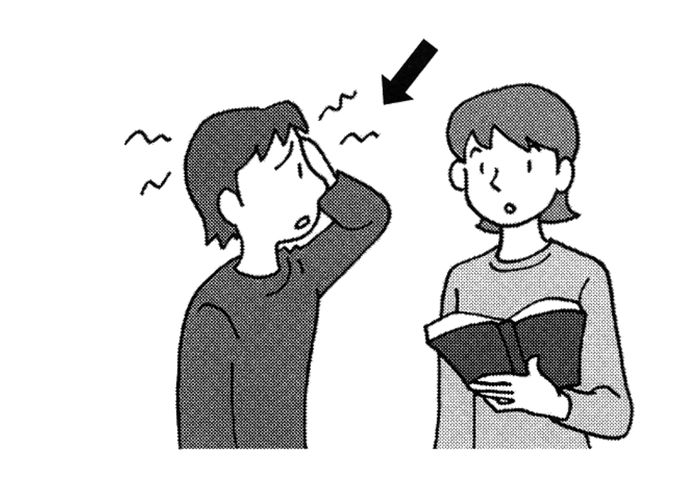
Listen to this sentence first
問 頭が痛いので早く帰りたいです。何と言いますか。
You have a headache and want to go home early. What do you say?
1早く帰らせていただけませんか。 ✓
Could you please let me go home early? (a humble request for permission)
2早く帰っていただけませんか。
Could you please go home early? (the person making the request is reversed)
3早く帰らせていただきましょう。
Then let me go home early, shall we? (a suggestion, which does not suit a request for permission to leave)
In the picture, one person is holding their head with a pained look (a headache), and the other is holding a book with a puzzled expression. The person with the headache should ask the other for permission to leave early. 早く帰らせていただけませんか combines the causative form with ていただけませんか, a humble request meaning "Could you please allow me to go home early?", politely asking for the other person's consent. 2 「早く帰っていただけませんか」 turns it into "Could you please go home early?", reversing who is making the request. 3 「早く帰らせていただきましょう」 uses 「ましょう」, a "let's..." suggestion, which does not suit a request for permission to leave. The answer is 1.
Q2
Listen to this sentence first
問 先生、最近せきが止まらないんです。きっとインフルエンザだと思うんです。
Doctor, my cough has been going on and on lately. I'm sure it's the flu.
1インフルエンザとは限りませんよ。 ✓
It's not necessarily the flu.
2インフルエンザでしょう?
It's the flu, right?
3せきが止まらないと思いますよ。
I think your cough will keep going on.
The patient says the cough won't stop and 「きっとインフルエンザだと思う」 ("I'm sure it's the flu"), which sounds very certain. The doctor should respond with a more cautious judgment: インフルエンザとは限りませんよ uses 「〜とは限らない」 (grammar point 93 of this lesson) to mean "it's not necessarily the flu," gently correcting the patient's overly definite conclusion. 2 「インフルエンザでしょう?」 instead confirms the patient's guess, which is not what you would expect from a doctor who should be more cautious. 3 「せきが止まらないと思いますよ」 merely repeats the symptom the patient already mentioned and does not respond to the question of whether it is the flu. The answer is 1.
Grammar in this question
〜とは限らない:(Grammar point 93 of this lesson) Means "not necessarily..."; used to gently deny an overly absolute judgment.
Key vocabulary
インフルエンザ influenza, the flu
Q3
Listen to this sentence first
問 準備が終わったところに雨が降ってきて、お祭り、中止になったんだ。
Just as we finished the preparations, it started raining, and the festival was cancelled.
1それは残念だったね。 ✓
That's too bad.
2お祭り、楽しかった?
Was the festival fun?
3早く準備した方がいいね。
You should get ready sooner, you know.
The speaker says the festival was cancelled because of rain, and there is a hint of disappointment. The most natural response is to express sympathy and regret: それは残念だったね. 2 「お祭り、楽しかった?」 presupposes that the festival was held, which contradicts the fact that it was cancelled. 3 「早く準備した方がいいね」 does not fit, because the speaker has already said the preparations were finished (準備が終わったところに), so this advice misses the point. The answer is 1.
Key vocabulary
中止になる to be cancelled, to be called off
Q4
Listen to this sentence first
問 この服、デザイン古いし、もう捨てるしかないかなあ。
This piece of clothing has an old-fashioned design. I guess I have no choice but to throw it out.
1うん、捨てっこないよ。
Yeah, there's no way you'd throw it out.
2うん、捨てるとは限らないよ。
Yeah, you don't necessarily have to throw it out.
3うん、捨ててもいいんじゃない? ✓
Yeah, it's fine to throw it out, isn't it?
The speaker is hesitating over whether to throw away an outdated piece of clothing, and 「もう捨てるしかないかなあ」 has the tone of asking "I guess all I can do is throw it out?" The most natural response is to agree: "Yeah, it's fine to throw it out, isn't it?" うん、捨ててもいいんじゃない? 1 「捨てっこないよ」 means "there's no way you'd throw it out," which contradicts the speaker's wish to throw it away. 2 「捨てるとは限らないよ」 uses a grammar point from this lesson (とは限らない), but it means "you don't necessarily have to throw it out," so it does not directly answer the speaker's hesitation about whether to throw it out. The answer is 3.
Grammar in this question
〜しかない:(Grammar point 88 of this lesson) Means "the only thing to do is..."; expresses that there is no other choice.