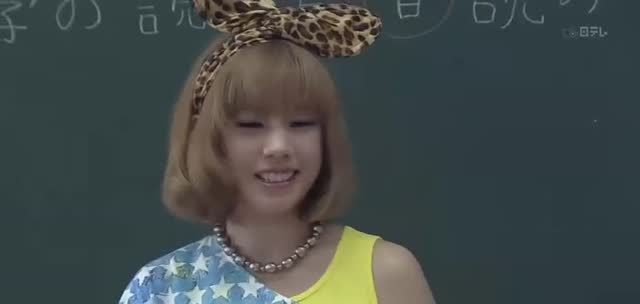
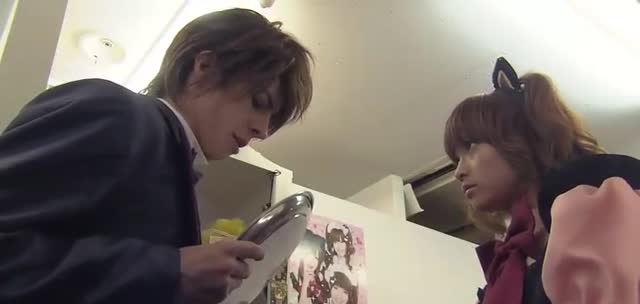
This episode has 50 conversation scenes: on-yomi and kun-yomi readings of kanji, how 「マジ」 is written and read, the discussion of why Japanese has no "standard language," the origin of 「です・ます」, character-flavored speech such as 「ざます」 and 「であります」, and lines for confessing love. The focus is on the patterns in kanji readings and how the common language relates to dialects.
Language highlights
「音読みと訓読み」(on-yomi and kun-yomi, the two kinds of kanji readings)
「本気と書いてマジ」(a kanji given a slangy reading through ruby)
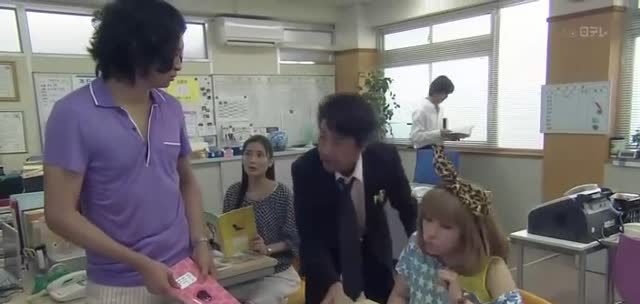
Morning at the end of the month. Haruko, with only a few coins left, tells Katori she is broke and tries to trade "keeping you company shopping" for a free lunch, while Katori picks at her wording.
鹿取
おはようございます!
Good morning!
ハルコ
うん…おはよう。
Mm... morning.
ハルコ/鹿取
私の全財産 326円だよ。 え~?お給料日まで まだ1週間以上ありますよ。
Haruko: My entire fortune is 326 yen, you know. — Katori: Huh? Payday is still more than a week away.
ハルコ/鹿取
じゃあ お昼おごってよ! 「じゃあ」の意味が分かりません。
Haruko: Then buy me lunch! — Katori: I don't understand what "then" means there.
ハルコ
買い物とかさ なんか いろいろ付き合ってあげるから。
I'll go shopping with you and keep you company and everything, so.
ハルコ
ほら 肩とか露出して 渋谷を落とさないと~ねっ!
Come on, show off your shoulders a bit. We have to win over Shibuya, right?!
ハルコ/鹿取
あっ!
Ah!
Speaking notes
付き合ってあげるから
giving-verb used to turn a favor into a bargaining chip
[Giving and receiving verbs] 「付き合ってあげるから」 = "I'll keep you company, so (buy me lunch)." Haruko uses 「あげる」: she presents "going shopping with you" as a favor she is doing and offers it in exchange for lunch. • 付き合う: to accompany; to go out with • 付き合ってあげる: I'll graciously keep you company (a bit condescending, half joking) • 付き合ってくれる: (you) kindly keep me company (gratitude) For the same action, 「あげる」means "I give to you" and 「くれる」means "you give to me". Haruko is really begging Katori to pay, yet she phrases it as if she were the one granting a favor. This kind of "reverse favor" is a common way in Japanese to joke your way into getting something.
「じゃあ」の意味が分かりません
Katori takes the conjunction literally and asks for the logic
Katori treats Haruko's 「じゃあ」 as a logical connector that needs justification. 「じゃあ」 = 「それでは」, "in that case / then", and should link a cause to a result. Haruko only said "payday is still a week away," and then jumps to 「じゃあ、お昼おごってよ」: one step is indeed missing ("because I have no money"). Katori points out the leap with 「〜が分かりません」 (polite and blunt). In real Japanese, 「じゃあ」 is often just a verbal habit for forcing a topic along and does not have to be logical.
お給料日
payday; 「お」 beautifies the word, 以上 includes the number
「給料日(きゅうりょうび)」 = payday. Most Japanese companies pay monthly on a fixed day (for example the 25th). • 「お給料日まであと〜日」 = ... days until payday • 「〜以上」 = ... or more (the number itself is included): 「1週間以上」 = a week or longer Katori's 「まだ〜以上ありますよ」 is a well-meant reminder: "you have to last more than a week." Note that 「お」 here is beautifying prefix (美化語), which Japanese speakers habitually add when talking about pay.
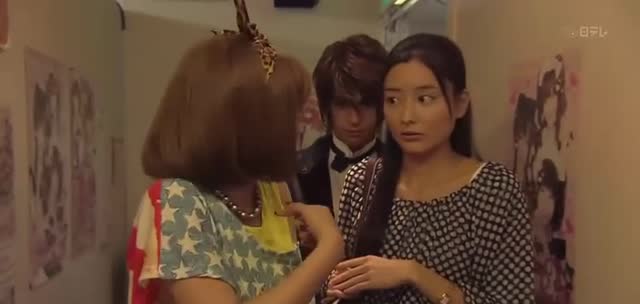
In the corridor, a crowd of girl students swarms around Luca. Haruko's ten-yen coin gets knocked out of her hand in the crush.
ルカ
困ります。 もう勘弁してください!
This is awkward for me. Please, spare me!
ハルコ
私の十円!もう! (女の子達の騒ぎ声)
My ten yen! Honestly! (The girls squealing)
鹿取
モッテモテですね ルカ君。 それに比べ…。
You're really popular, aren't you, Luca? Compared to that...
ハルコ
フッ!比べるな。
Hmph! Don't compare.
Speaking notes
モッテモテ
モテる: to be popular with the opposite sex; reduplication for emphasis
「モテる」 = to be popular with the opposite sex; 「モテモテ」 = hugely popular. 「モッテモテ」 adds a geminate (small っ) and a lengthened sound for exaggeration: wildly popular. • 「モテない」: not popular • 「モテ期」: a period of sudden popularity in love Katori is stating a fact, but with 「それに比べ…」 she pulls Haruko into the comparison and stops mid-sentence, leaving the listener to finish it ("...and you don't have a single yen"). Leaving a comparison unspoken like this is a very indirect Japanese way to sting someone.
勘弁してください
please let me off; spare me
「勘弁(かんべん)してください」 = please let me off / please spare me. It can beg for mercy or refuse (「それは勘弁して」 = I'll pass on that). Luca first says 「困ります」 ("that's a problem for me") and then 「もう勘弁してください」, raising the intensity step by step.
比べるな
verb dictionary form + な = prohibition: don't do it
「比べるな」 = don't compare. Dictionary-form verb + 「な」 = the prohibitive form, a forceful tone: • 食べるな / 行くな / 見るな Haruko uses the prohibitive to a colleague, which shows she has really been hit where it hurts. The 「フッ!」 is a forced, nonchalant snort.
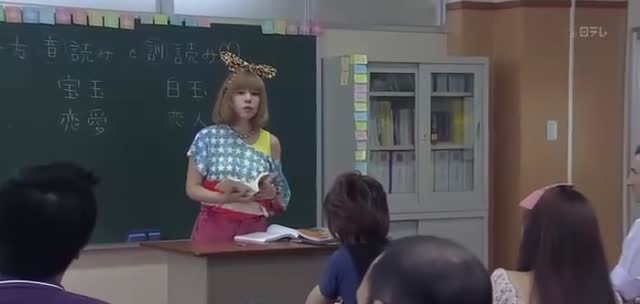
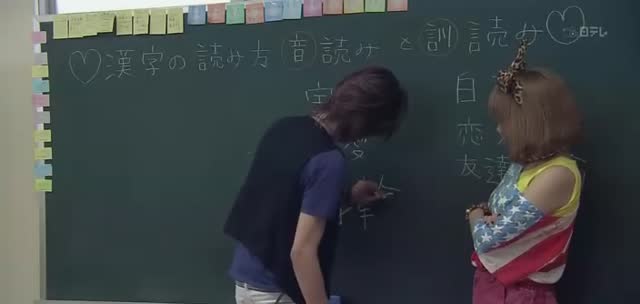
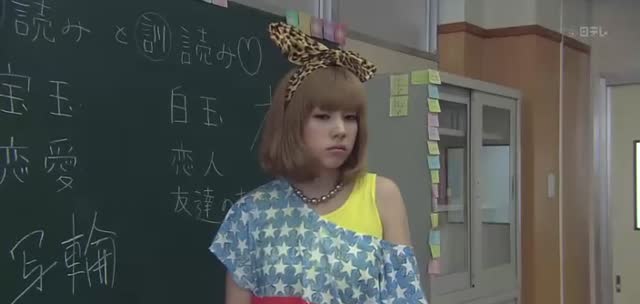
The new lesson is on-yomi and kun-yomi of kanji. Haruko picks 玉 as her example, but the students have their eyes on a character in the textbook.
ハルコ
漢字には 音読みと訓読みの 2種類があります。
Kanji have two kinds of readings: on-yomi and kun-yomi.
ハルコ
じゃ 例えばね 「玉」という字は…。
So, for example, the character 玉...
ハルコ
音読みは 「宝玉」で→
The on-yomi is the one in 「宝玉」 (hougyoku).
ハルコ
訓読みが 「白玉」と読みます。
The kun-yomi is read as in 「白玉」 (shiratama).
ポール
教科書には「金」って 書いてあるけど?
But the textbook says 金, doesn't it?
Speaking notes
音読みと訓読み
on-yomi: Sino-Japanese reading; kun-yomi: native Japanese word reading
[Core knowledge] Japanese kanji have two kinds of readings: • 音読み(おんよみ): based on the pronunciation that came into Japan together with the character. For example 「山」 = サン, 「玉」 = ギョク. • 訓読み(くんよみ): reads the character with a native Japanese word of the same meaning. For example 「山」 = やま, 「玉」 = たま. Example: 宝玉(ほうぎょく) is on-yomi and 白玉(しらたま) is kun-yomi.
書いてあるけど?
〜てある: a state left behind by someone's action
「書いてある」 = it is written there (someone wrote it, and it stays that way). 「〜てある」 is transitive verb + 「ある」, showing the resulting state of an action: • 「ドアが開けてある」 = the door has been opened (by someone, on purpose) • 「窓が開いている」 = the window is open (natural state) With 「教科書には〜と書いてある」, Paul cites an authority to push back: "it's not me, it's the textbook." The sentence-final 「けど?」 leaves room for doubt, like "are you sure?", polite yet challenging.
What Haruko wrote on the blackboard differs from the textbook. The students keep pressing her on whether it is 白 or 金.
ハルコ
次に「恋」っていう字だけど…。
Next is the character 恋, but...
ポール
「白」じゃなくて「金」だよ~。
It's not 白, it's 金!
ハルコ/ポール
音読みは「恋愛」の…。 だから「金」だって。
Haruko: The on-yomi is the one in 「恋愛」... — Paul: So I'm telling you, it's 金.
ジャック/ハルコ
すいません。 あ~もう!わかったわよ!
Jack: Excuse me. — Haruko: Aaah, fine! I get it!
ハルコ
金の玉と書いて「きんたま」よ!
It's written 金の玉 and read "kintama"!
ジャック/ハルコ
いえ…音読みと訓読みの違いは? えっ?
Jack: No... what's the difference between on-yomi and kun-yomi? — Haruko: Huh?
ジャック
漢字には なぜ二種類の読み方が あるのですか?
Why do kanji have two kinds of readings?
Speaking notes
金の玉
the vulgar word the students were fishing for
The joke here: the students insisted on 金 because they wanted Haruko to say a vulgar word out loud. Cornered, she reads 「金」+「玉」 in the most blunt way, producing a crude slang word that does not belong in a classroom (a slang term for male genitals). The language point: 「金」 is on-yomi 「キン」 and 「玉」 is kun-yomi 「たま」, and reading them together gives this word. A word that mixes on-yomi first and kun-yomi second is called 「重箱読み(じゅうばこよみ)」; the reverse order (kun + on) is 「湯桶読み(ゆとうよみ)」.
わかったわよ!
わよ: feminine ending; reluctantly giving in
「わかったわよ!」 = Okay, I get it! The feminine-sounding 「わよ」 plus an exclamation mark expresses "pushed to the limit, giving in out of spite." Compare: • 分かった: (neutral) • 分かったよ: (easygoing) • 分かったわよ!: (impatient, giving way with a huff) After being hounded by the students, Haruko throws caution to the wind, which is why she blurts out that word.
なぜ二種類の読み方があるのですか
Jack asks the key question: why two readings?
「なぜ〜のですか」 = Why is it that ...? Jack asks the key question of the lesson: why are there two readings? Grammar: 「〜のですか」 is a polite question that asks for an explanation, pressing for the reason more than plain 「〜ですか」 does.
Pressed by the students on a basic question about kanji, Haruko turns serious and starts explaining that ancient Japan had no writing.
ハルコ
あ…それはね えっと…。
Ah... well, that's because, um...
金麗
珍しく予習してきたの?
Did you actually prepare for once?
ハルコ
珍しくって言うな。
Don't say "for once."
ハルコ
えっと…日本に まだ 文字が無かった大昔にね→
Um... long, long ago, when Japan still had no writing,
ハルコ
モノの名前は全て 丸暗記してたの。
people memorized the names of everything by heart.
ハルコ
だけどさ 人には限界ってものが あるでしょう?
But, you know, people do have their limits, right?
ハルコ
だから 中国の漢字を 習い始めてね…。
So they started learning kanji from China...
Speaking notes
珍しく〜してきた
珍しく: unusually, for once (adverb)
「珍しく」 = unusually; for once. It is the adverbial form of the adjective 「珍しい」: • 「珍しく早起きした」 = I got up early for once Jin Li's 「珍しく予習してきたの?」 is teasing: you never prepare normally. Haruko protests at once with 「珍しくって言うな」: she was caught out and doesn't want to admit it. Note 「〜てきた」: comes having done something first (came after preparing).
人には限界ってものがある
〜ってものがある: there is such a thing as ...
「ってものがある」 = there is such a thing as ... A colloquial form of 「〜というものがある」, used to remind someone of common sense: • 「常識ってものがある」 = there is such a thing as common sense This "theory of limits" is Haruko's own invention, used to explain why Japan brought in kanji: people couldn't remember it all. Note that she deliberately uses the colloquial 「〜ってもの」 rather than the written-style 「限界がある」.
丸暗記
rote memorization of the whole thing
「丸暗記(まるあんき)」 = memorizing the whole thing without understanding it. 「丸」 = whole, 「暗記」 = memorization. • 「丸暗記する」: to learn by rote • 「丸写し」: to copy wholesale The logic of Haruko's story: no writing → memorize the name of every object → the human brain is limited → so borrow kanji.
Haruko uses the character 山 to explain where on-yomi and kun-yomi come from: Japan already called that thing 「やま」, so how should it be written with kanji?
ハルコ
日本では あれを 「やま」と呼んでるんだけど→
In Japan, we call that thing 「yama」, but...
ハルコ
中国の漢字で どうやって書くの?
how do you write it with the kanji from China?
ハルコ/生徒
サン。 へえ~じゃあ この字の読み方は→
Student: "San." — Haruko: I see~ then, how this character is read...
ハルコ
「やま」と「サン」にするよ。
we'll make it 「yama」 and 「san」.
ハルコ
っていうふうに 音読みと訓読みが 出来たのです。
And that is how on-yomi and kun-yomi came to exist.
Speaking notes
「やま」と「サン」
native word and Sino-Japanese word merge into one character
This is the origin of on-yomi and kun-yomi: ① Japan already had the spoken word 「やま」 (a native word, 和語). ② The kanji 「山」 arrived with the sound 「サン」 (a Sino-Japanese word, 漢語). ③ The Japanese gave the character both readings at once: they kept their own 「やま」 (kun) and also accepted 「サン」 (on). The result is one kanji with two pronunciations: • 山登り(やまのぼり)/ 富士山(ふじさん) Haruko's account is very simplified (historically there are also distinctions such as 呉音・漢音・唐音).
っていうふうに
a summing-up phrase: and that's how it was
「〜というふうに」 = in this way; like so. In speech it works as a summarizing wrap-up: • 「こういうふうに書く」 = you write it like this After a long explanation, Haruko closes with 「っていうふうに」, which means "that's how it is, got it?" Note that at the end she switches to 「のです」 (written style plus polite): in front of the whole class she is still "the teacher."
The students nod and then start squabbling: Diana says it must be easy for Wang since there are not two readings to learn. Wang objects right away and corrects Haruko's pronunciation.
ダイアナ/王
中国人は 楽ですね。 楽じゃないよ。
Diana: You have it easy, don't you. — Wang: No, we don't.
王/ハルコ
正しくは「シャン」だよ。 シャン?
Wang: The correct pronunciation is "shan." — Haruko: "Shan"?
王/ハルコ
そうよ! 中途半端にパクらないでよ!
Haruko: That's right! Don't just half-copy it!
王
パクったんじゃありません。 習ったんです!
I didn't copy it. I learned it!
マリー
喧嘩は およしなさい。 友達の輪でしょ?
Stop fighting, please. We're a circle of friends, aren't we?
Speaking notes
パクる
パクる: slang for copying or lifting something without permission
「パクる」 = to copy or take (without permission); it is also underworld slang for "to arrest." • 「デザインをパクる」 = to rip off a design Someone accuses Japan of "taking kanji but reading them wrong." The retort 「パクったんじゃありません、習ったんです!」 is a defense that Japanese people make with complete confidence: not stealing, but learning. Note the contrast of register: 「パクる」 is blunt slang, while 「習った」 is the neat, proper verb for learning from someone.
およしなさい
お〜なさい: polite-sounding command to stop
「およしなさい」 = please stop. 「お+verb stem+なさい」 is a command form built on honorific language: • おやめなさい / お待ちなさい Marie steps in to mediate in her "madam" voice. 「友達の輪でしょ?」: 「輪(わ)」 = circle.
楽ですね
楽: easy, comfortable; also a character with two on-yomi
「楽(らく)」 = easy; comfortable. 「楽(がく)」 = music. Note that 「楽」 is a character that has two on-yomi: らく (呉音) and がく (漢音). Diana's 「…は楽ですね」 means "you don't have to memorize two sets of readings," and Wang answers 「楽じゃないよ」.
The topic moves to the reading of the character 輪. Haruko asks the students for its on-yomi, and every answer they give comes from manga.
ハルコ/生徒
じゃあ 輪の音読み分かる? イタリアのイケメン。
Haruko: So, do you know the on-yomi of 輪? — Student: The handsome Italian guy.
ルカ/ハルコ
りん。 はい。
Luca: "Rin." — Haruko: Yes.
ハルコ/ルカ
じゃあ 「りん」を使って 他の漢字 書ける? オッケー。
Haruko: Then can you write another kanji using "rin"? — Luca: OK.
ハルコ
「しゃりん」の「しゃ」は…。
The "sha" in 「sharin」 is...
ルカ
これね。
This one, right?
ルカ/ハルコ
いえ 写輪眼です。 え?
Luca: No, it's 写輪眼 (Sharingan). — Haruko: Huh?
ルカ/ハルコ
ナルトのサスケの めんたま。 ああ…漫画?
Luca: Sasuke's eyeballs from Naruto. — Haruko: Oh... manga?
Speaking notes
写輪眼
a manga term turned into a kanji lesson
「写輪眼(しゃりんがん)」 is an eye technique from the manga NARUTO, and its name is made of kanji. The joke: Haruko is after 「車輪(しゃりん)」 (wheel), where 「車」 is read シャ and 「輪」 is リン. But Luca writes 「写」 from "写輪眼," which also contains 「しゃりん」. Note: 「写」 does have the on-yomi 「シャ」, so he is correct as far as sound goes, but the meaning has gone completely off track.
めんたま
目ん玉: eyeball (coarse, colloquial)
「めんたま(目ん玉)」 = eyeball. Colloquial and a bit rough. 「目」 becomes 「目ん」 (sound link) and 「玉」 means ball.
Luca says he learned kanji from the furigana in manga. The other students rattle off manga titles one after another: Inuyasha, Akira, Cobra and more.
ルカ
漢字は漫画のふりがなで 覚えました。
I learned kanji from the furigana in manga.
生徒/ボブ
犬夜叉! アキラ! コブラ!
Student: Inuyasha! — Bob: Akira! Cobra!
生徒/エレーン
アラレちゃん かわいいよ。 忍者ハットリ君!
Student: Arale-chan is so cute. — Elaine: Ninja Hattori-kun!
ハルコ
あ~ 外国人って そういう風に 漢字覚えるんだ。
Ah~ so that's how foreigners learn kanji.
生徒/ハルコ
アンパンマン ちょっと まあまあ…ね!
Student: Anpanman. — Haruko: Hey, now, come on... right!
ハルコ
あ!じゃあ…。
Oh! Then...
Speaking notes
ふりがな
small kana printed beside a kanji to show its reading
「ふりがな(振り仮名)」 = the small kana written beside a kanji to show how it is read.Manga, children's books and newspapers often add it. Luca says 「漢字は漫画のふりがなで覚えました」: he did not study the kanji themselves, he memorized "kanji + kana" as pairs. This way of learning gives good pronunciation and a rich vocabulary, but you know words rather than characters: he can read 「本気」, yet cannot say what the on-yomi and kun-yomi of 「本」 and 「気」 are on their own.
そういう風に
そういう風に: in that way (風 = manner)
「そういう風に」 = in that way. 「風(ふう)」 = manner, style: • 「こういう風に」 = like this • 「どういう風に」 = in what way Haruko's 「外国人ってそういう風に漢字覚えるんだ」 is a small sigh of discovery, and the ending 「〜んだ」 means "so that's how it is!".
犬夜叉・アキラ・コブラ
the students cite manga and anime titles as evidence
What the students shout are titles of Japanese manga and anime: 「犬夜叉」, 「AKIRA」, 「コブラ」, 「Dr.スランプ アラレちゃん」, 「忍者ハットリくん」 and 「アンパンマン」. An interesting language phenomenon: many foreign students pick up their Japanese vocabulary "in chunks" from manga and anime. So they can say 「マジ」「デカ」「ツンデレ」 and other "manga-style expressions" yet may not know the ordinary words 「本当」 or 「刑事」.
Haruko quizzes the class on how to read the word 本気, and the students all answer "maji" in chorus.
ハルコ
これ 何て読むか分かる?
Do you know how this is read?
生徒たち
マジ。 本気。
Students: Maji. — Honki.
生徒
漫画にマジって書いてあったぞ。
It said "maji" in manga!
ハルコ/ルカ
何?これ。 同人誌。
Haruko: What is this? — Luca: A doujinshi.
ハルコ
同人誌?
A doujinshi?
Speaking notes
本気でマジ
a kanji given a slangy reading through ruby in manga
The normal reading of the kanji 「本気」 is 「ほんき」, but manga often prints 「マジ」 beside it. This is a manga device that plays kanji (meaning) against kana (sound): the kanji gives the meaning, but the word is pronounced in a colloquial way: • 本気(マジ): serious • 敵(とも): written "enemy," read "friend" This kana is called 「ルビ」. The reader sees the kanji with the eyes and hears the kana in the head, producing a double meaning.
同人誌
fan-made magazine or comic, self-published by amateurs
「同人誌(どうじんし)」 = a magazine or comic made and self-published by people who share an interest. They are mostly sold at 「コミケ(コミックマーケット)」.
Luca takes out his doujinshi, in which the kanji carry flamboyant kana readings. Haruko cracks a joke when he finishes.
ルカ
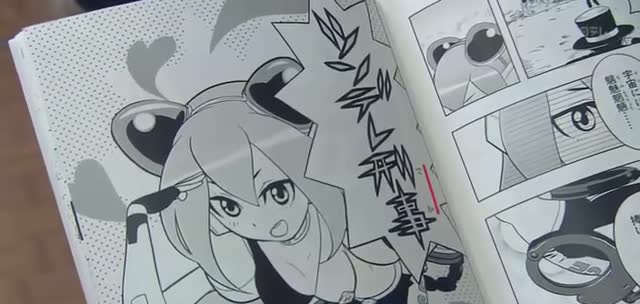
「宇宙にはびこる魑魅魍魎→
"The ghosts and goblins that infest the universe,
ルカ
闘うことが運命ならば 本気でこの身を捧げよう。→
if fighting is destiny, I will offer up my body in all seriousness.
ルカ
その名も人呼んで ツンデレ刑事」
Known to all by the name: Tsundere Detective."
ルカ
「死なせないわ わたしの敵よ」
"I won't let you die. You are my 敵 (read: tomo)."
ルカ
という意味です。
That's what it means.
ハルコ
敵に送ったら ただのプレゼントじゃん。
If you send that to an enemy, it's just a present, isn't it?
Speaking notes
魑魅魍魎
goblins and demons of all kinds; a very literary phrase
「魑魅魍魎(ちみもうりょう)」 = all kinds of mountain spirits, goblins and monsters; figuratively, assorted villains. It is a very heavy, bookish word full of difficult kanji, popular in edgy action manga and special-effects shows. But in daily conversation, almost nobody uses this word. The whole passage is in a hot-blooded, edgy style: 闘う・運命・捧げる are all written-language or literary words.
敵
敵 read as とも: ruby that contradicts the kanji
The kanji 「敵」 is normally read 「てき」 and means "enemy," but here the manga prints the ruby 「とも」 (友) beside it. It is a classic manga device in the spirit of 「強敵と書いて友と読む」: the strong rival is also a dear friend. Luca's 「死なせないわ わたしの敵(とも)よ」 = "I won't let you die, you are my 'enemy' (that is, my friend)." Haruko's retort 「敵に送ったらただのプレゼントじゃん」 comes from her reading 敵 as 「てき」 (enemy) in the usual way: doing that for an enemy would just be handing them a present. It is a typical misreading caused by looking only at the kanji.
ツンデレ
cold on the outside, sweet on the inside; a character type
「ツンデレ」 = a personality that is cold (ツンツン) most of the time but becomes shy and sweet (デレデレ) at the crucial moment. It is a key word in Japanese otaku culture. • ツン: cold, prickly • デレ: lovey-dovey, sweet Luca's detective is a 「ツンデレ刑事(デカ)」. Reading 「刑事」 as 「デカ」 is police slang, and it is another example of "kanji + kana".
Haruko remembers she is the teacher and tells the students that readings like 「マジ」 and 「デカ」 in manga are ones the manga author thought up and added.
ハルコ
ここに書いてある「マジ」とか 「デカ」とかいう ふりがなは→
The furigana written here, like "maji" and "deka,"
ハルコ
漫画の作者の人が 考えて つけた読み方で→
are readings that the manga's author came up with and added,
ハルコ/ボブ
正しい読み方じゃないからね。 漫画の作者なら いいのかよ?
so they're not the correct readings, okay? — Bob: So it's fine if it's a manga author?
ルカ
この作者 僕ですけど?
Luca: I'm the author of this, though?
ハルコ
え?これ ルカが描いたの?
Huh? You drew this, Luca?
ハルコ
でもこれ ただの趣味でしょ? 私が言ってる作者っていうのは→
But this is just a hobby, right? When I say "author,"
ハルコ
こうやって漫画を描いて ちゃんと お金をもらってる人のことなの。
I mean someone who draws manga like this and actually gets paid for it.
Speaking notes
つけた読み方
past-tense verb modifying a noun: a reading that was made up
「考えてつけた読み方」 = a reading that (the author) thought up and attached. Past-tense verb + noun expresses "the result of an action already completed": • 「作った料理」 = the dish (someone) made • 「つけた名前」 = the name (someone) gave Haruko's "rule" is: the ruby in manga is "invented by the author," not a "correct reading" in the linguistic sense. Luca's comeback "I'm the author" turns the rule into a question of "who gets to make the rules".
作者っていうのは
〜っていうのは〜こと: used to define a term
「作者っていうのは〜ことなの」 = "by author I mean someone who..." This is a colloquial pattern for giving a definition: 「AというのはBのことだ」. Haruko narrows "author" down to "someone who gets paid for it", using income to draw the line between professional and amateur.
ただの趣味
ただの: just a, merely ordinary
「ただの趣味」 = just a hobby. 「ただの」 = ordinary, nothing special. • 「ただの友達」 = just a friend Haruko's words are a little stinging: your creation is merely a hobby.
Luca says he earned 300,000 yen from one doujinshi, and Haruko's eyes light up.
ルカ
ルカも30万円もらったよ。
Luca got 300,000 yen too.
ハルコ
30万!?これが?
300,000?! From this?
ルカ/金麗
よくコミケで売れましたよ。 ハルコより 稼いでるんじゃないの?
Luca: It sold well at Comiket. — Jin Li: You might be earning more than Haruko, aren't you?
ハルコ
ねぇ ルカ!私 漫画描くの 手伝ってあげようか?
Hey, Luca! Shall I help you draw your manga?
金麗
何でハルコが手伝うのよ!
Jin Li: Why would Haruko help?!
ハルコ
わかんないかなぁ。 もっと売れる漫画を描くには→
Don't you get it? To draw manga that sells even better,
ハルコ
日本人の気持ちを わかっとかなきゃ。
you have to understand how Japanese people feel.
Speaking notes
手伝ってあげようか
Shall I help you? An offer made with あげる
[Giving and receiving verbs] 「手伝ってあげようか?」 = "Shall I help (you with it)?" The volitional form of 「あげる」 + 「か」 is an offer of help. Notice Haruko's "motive": it is not pure kindness, but a "partnership proposal" after seeing "300,000 yen." So her 「あげる」 is purposeful: behind the favor is a wish to get a cut. Jin Li sees through it at once with 「何でハルコが手伝うのよ!」.
わかんないかなぁ
わかんないかなぁ: exasperation that someone doesn't get it
「わかんないかなぁ」 = "Why can't you understand?" 「分からない」 → 「わかんない」, plus 「かなぁ」 for "how come?" exasperation: • 「どうしてわからないのかなぁ」 The tone is condescending: Haruko puts herself on the "understanding" side and Jin Li on the "not understanding" side.
わかっとかなきゃ
〜ておかなきゃ: must do it beforehand; contracted speech
「わかっとかなきゃ」 = a colloquial contraction of 「わかっておかなければ(ならない)」. 「〜ておく」 means "do something in advance as preparation," and 「〜なきゃ」 contracts 「〜なければ」: • 「覚えておかなきゃ」 = I have to memorize it beforehand Haruko's logic: to sell manga well, you have to understand Japanese readers' psychology "in advance."
Haruko sets her terms for Luca: her fee will be only half of the profits. Luca looks bewildered while the students heckle from the side.
ハルコ/ルカ
…日本人の気持ち? いいよ いいよ!
Haruko: ...Japanese people's feelings? — Luca: No, no, that's okay!
ハルコ
あのね ギャラは 儲けの半分でいいから。
Look, my fee is just half of the profits, so that's fine.
ルカ/ポール
半分!? ぼったくりだぞ。
Luca: Half!? — Paul: That's a rip-off!
ハルコ
ルカ 一緒に 漫画御殿 建てようね!
Luca, let's build a manga mansion together!
ルカ/ハルコ
描けません…。 いやいや…。
Luca: I can't draw it... — Haruko: No, no...
ハルコ
じゃあ 6:4でいいから。
Then sixty-forty is fine.
ルカ/ハルコ
僕の日本語 たぶん通じません。 ん?
Luca: My Japanese probably won't get through. — Haruko: Hm?
ハルコ
通じないって…ごめん 何の話?
Won't get through...? Sorry, what are you talking about?
Speaking notes
ぼったくり
a rip-off; charging an unreasonable price
「ぼったくり」 = charging an unreasonably high price; a rip-off. It is the noun form of the verb 「ぼったくる」: • 「ぼったくりバー」 = a bar that overcharges customers The students blurt out 「ぼったくり」 at Haruko's 「ギャラは儲けの半分でいいから」: half of the profit is indeed excessive for someone who just "provides ideas." Note Haruko's 「〜でいいから」: "just ... is fine" sounds like a concession, but in fact asks for a lot.
漫画御殿
〜御殿: a mansion built on a successful business
「漫画御殿(まんがごてん)」 = a mansion built on manga earnings. 「御殿」 = palace, grand residence. In Japanese, 「〜御殿」 is often used for a house built after getting rich in some business: • 「ラーメン御殿」「うなぎ御殿」 Haruko says it half in jest and half in earnest.
通じません
通じる: to get through; to be understood
「通じる」 = (a language or an idea) gets through and is understood. When Luca says 「僕の日本語、たぶん通じません」, he is not talking about "the manga" but about "his confession". Haruko completely misses it and is still thinking about the profit split, so she asks 「何の話?」: the two are not talking about the same thing at all.
Luca tells Haruko about his trouble, but one word in his Japanese comes out wrong, and Jack points it out.
ルカ
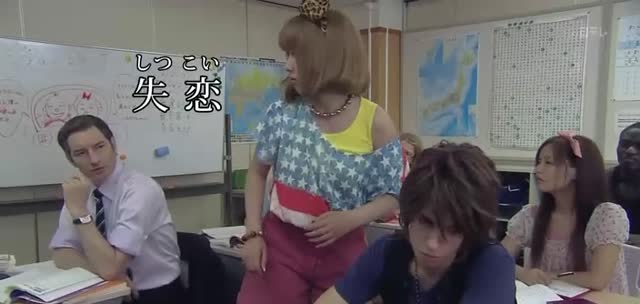
しつこい。
Shitsukoi.
ルカ
しつこいするかも…。
I might do shitsukoi...
ハルコ
ん?しつこいする?
Hm? "Do shitsukoi"?
ジャック
それは「しつこい」ではなく→
Jack: That's not "shitsukoi,"
ジャック
音読みの 「失恋」ではありませんか?
it's "shitsuren" with the on-yomi, isn't it?
ハルコ
失恋!?ルカが?
Shitsuren?! Luca?
Speaking notes
しつこい/失恋
しつこい and 失恋: mixing on-yomi and kun-yomi
What Luca meant to say was 「失恋(しつれん)」, but it came out as 「しつこい」. Both start with 「しつ」; the difference is in what follows, 「れん」 versus 「こい」: • 失恋(しつれん): lost love (on-yomi: 失 = シツ, 恋 = レン) • しつこい: persistent; clingy; obstinate The kun-yomi of 「恋」 is 「こい」! So Luca read 「恋」 with its kun-yomi and got 「しつこい」 (失 + 恋): a misreading from mixing on-yomi and kun-yomi.
〜する (noun + する)
noun + する makes verbs, but not adjective + する
Luca's 「しつこいする」 is a misreading of 「失恋する」. In Japanese, 「noun + する」 builds many verbs (勉強する, 失恋する), but the adjective 「しつこい」 cannot take 「する」 directly. Haruko's 「しつこいする?」 repeats it back as is, with puzzlement, a typical correction by echoing. Jack's correction, 「しつこい」ではなく、音読みの「失恋」ではありませんか, uses the concept of "on-yomi" to point out the right reading.
Luca begs Haruko to teach him how to win a girl over. Haruko first checks whether he means chatting someone up and pursuing her.
ルカ
ハルコ!女の子の落とし方 教えてください!
Haruko! Please teach me how to win a girl over!
ハルコ
いや 落とし方って 口説き方ってこと?
No, wait, by "how to win one over" do you mean how to hit on a girl?
ルカ
僕 崖っぷちです!
I'm standing at the edge of a cliff!
ルカ
漫画いっぱい描いたげますから 助けて ハルコ!
I'll draw you lots of manga, so please help me, Haruko!
Speaking notes
落とし方/口説き方
落とす: to win over, outcome; 口説く: to woo with words, process
「落とす」 = to "win over" someone romantically; 「口説く」 = to woo or persuade with words. The difference: • 落とす: result-oriented (to conquer, to land someone), with a hint of "hunting" • 口説く: process-oriented (persuading, courting) Haruko's correction 「落とし方って口説き方ってこと?」 is really asking: "do you want a 'technique' or 'sincerity'?"
崖っぷち
edge of a cliff: driven into a corner
「崖っぷち(がけっぷち)」 = the edge of a cliff; figuratively, "driven to the brink." • 「崖っぷちに立たされる」 = to be pushed to the brink Luca uses a very dramatic metaphor (the kind seen in manga) to show that he has "nowhere left to retreat" in this love.
描いたげます
描いたげます: casual contraction of 描いてあげます
[Giving and receiving verbs] 「描いたげます」 = a casual contraction of 「描いてあげます」. 「〜てあげる」 → 「〜たげる」 (common in young people's speech). Luca uses 「あげる」 to put himself in the "giver" position: "I'll give you manga as payment." This is a favor offered as an even exchange.
In the teachers' room, Haruko tells Shibuya and Katori about Luca's trouble with confessing his feelings. Shibuya has never heard of an Italian who can't confess, and Katori guesses it might be because he is an otaku.
渋谷
初めて聞いたよ。 告白できないイタリア人なんて。
That's a first. An Italian who can't confess his feelings.
鹿取
オタクだからですか?
Is it because he's an otaku?
ハルコ
問題はオタクじゃない 日本語よ。
The problem isn't that he's an otaku. It's his Japanese.
ハルコ
相手に日本語が通じないみたい。
It seems like the other person doesn't understand his Japanese.
ハルコ
結構 丁寧な標準語 喋ってると思うんだけどねぇ。
I'd think he's speaking pretty polite standard Japanese, though.
鷹栖
標準語なんてものは 日本語には ねぇぞ。
There's no such thing as "standard language" in Japanese.
鹿取/ハルコ
標準語と呼ばれている言葉は 共通語と言われてるんです。 共通語?
Katori: What's called "hyoujungo" is actually referred to as "kyoutsuugo." — Haruko: Kyoutsuugo?
Speaking notes
標準語なんてものはない
なんてものはない: flat denial that such a thing exists
Takasu's declaration: 「標準語なんてものは日本語にはねぇぞ」 = there is no such thing as a "standard language" in Japanese. The pattern 「〜なんてものはない」 = "there's no such thing as ...", a strong denial with a touch of contempt. 「ねぇ」 is the rough contraction of 「ない」. Takasu does not explain "why"; Katori follows up in the polite style: 「標準語と呼ばれている言葉は共通語と言われているんです」.
標準語と共通語
標準語 was a prescribed norm; 共通語 is the language people share
[Core knowledge] • 標準語(ひょうじゅんご): the "standard" that the government of the Meiji period tried to set artificially (based on the Yamanote speech of Tokyo) • 共通語(きょうつうご): the common language that formed naturally so that people from all over the country could communicate Today linguists and educators mostly use 「共通語」, because "standard" implies that other dialects are "non-standard."
通じないみたい
〜みたい: an impression based on what one has observed
[そう / よう / みたい / らしい] 「通じないみたい」 = it seems it isn't getting through. Haruko uses 「みたい」 because she is "inferring" this from what Luca said, not confirming it with her own eyes. • 〜らしい: something heard from others • 〜みたい: an impression from one's own observation
Takasu suspects Haruko has an ulterior motive and says she is not the type to give students advice for free. Shibuya hurries to say a good word for her.
鷹栖
おめえ なに企んでんだ?
Hey, you. What are you scheming?
鷹栖
ただで生徒の相談に乗るような タマじゃねぇよな?
You're not the type to take on a student's problem for free, are you?
渋谷
いやいや 生徒想いなんですって ハルコ先生は。
No, no, Ms. Haruko really cares about her students.
鷹栖
えぇえ?何?このアメリカ的なの 丸出しの女が?
Huh? What? This woman who's American-style through and through?
渋谷
素晴らしいじゃないですか 個性的で。なあ?
Isn't it great? She's got personality. Right?
鹿取/ハルコ
個性的ですか…。 そうよ!
Katori: Personality, is it... — Haruko: That's right!
ハルコ
買いかぶらないでくれる?
Don't overrate me, would you?
ハルコ
見くびらないでください!
Please don't underestimate me!
Speaking notes
買いかぶる/見くびる
買いかぶる: to overrate; 見くびる: to underrate
[Contrast] 「買いかぶる」 = to overrate (to think better of someone than they deserve); 「見くびる」 = to underrate (to look down on). • 買いかぶる: to overestimate (「買いかぶらないでください」 = don't give me too much credit) • 見くびる: to belittle (「見くびるな」 = don't underestimate me) Haruko says 「買いかぶらないでくれる?」 (don't overrate me) and right away adds 「見くびらないでください!」 (don't underestimate me): the first deflects Shibuya's praise, the second bristles at Takasu's suspicion, so she is turning on both men in a row.
タマじゃねぇよな
タマ: slang for a type of person
「〜のタマじゃない」 = you're not the type of person who... In colloquial speech, 「タマ(玉)」 can mean "a person, a character," often with a negative tone: • 「そんなタマじゃない」 = you're not that sort of person Takasu's tone is doubtful: you are not someone who would help "for free,"implying that Haruko must have an angle.
アメリカ的なの丸出し
丸出し: showing everything, with nothing hidden
「丸出し(まるだし)」 = fully exposed, with nothing hidden. • 「田舎丸出し」 = country bumpkin written all over Takasu's 「アメリカ的なの丸出しの女」 refers to Haruko's clothes and air being "totally American" (flashy, shoulders bared). Note 「〜的なの」: 「アメリカ的」 (American-style) + 「なの」 (the kind of thing), a pronoun-like use that drops the noun: "this American-style sort of thing."
Staff: Akiba is the dream destination for otaku all over the world.
Speaking notes
お帰りなさいませ
Welcome home! the maid cafe greeting
「お帰りなさいませ」 = Welcome home. In a maid cafe, the staff treat customers as "masters or young ladies returning to the mansion": • お帰りなさい: (among family) welcome home • お帰りなさいませ: a more respectful welcome (to a "master") [Honorifics] 「〜ませ」 is the imperative form of 「ます」 and gives a respectful greeting, with the same structure as 「いらっしゃいませ」. Maid cafes have turned the whole package of "honorific language + role play" into a product.
お嬢様
honorific for a young lady; what maid cafes call female guests
「お嬢様(おじょうさま)」 = an honorific for a daughter of a good family. In maid cafes, male customers are addressed as 「ご主人様」 and female customers as 「お嬢様」. Note that one student reacts very naturally: 「家ではいつもそう呼ばれてますけど」. This is a real "young lady" responding to a "performed young lady."
うちら
うちら: casual word for we, used by young speakers
「うちら」 = we (casual, used by women and young people), more relaxed than 「私たち」. • 「うちら友達だよね」 = we're friends, right? By saying 「うちら」, Haruko blends into the circle of "young girls," but this 「うちら」 includes both "students and teacher," which also shows her putting herself on the same side as the students.
On the cafe's stage, the maids are singing and dancing. Haruko realizes her students have come along too.
ハルコ/生徒
ねえ 何ですか これ? 知らないわよ!
Haruko: Hey, what is this? — Student: I don't know!
生徒/ハルコ
ハルコ! エレーン!?
Student: Haruko! — Haruko: Elaine?!
金麗
同人誌で ぼったくるつもりね?
You're planning to rip people off with a doujinshi, aren't you?
ハルコ
ちょっと…何でもないから 何でもない。シーッ!
Wait... it's nothing, it's nothing. Shh!
ハルコ/生徒
ダイアナさん。 カトリーナ!
Haruko: Diana. — Student: Katrina!
鹿取
カトリーナじゃなくて 鹿取です!
It's not Katrina, it's Katori!
Speaking notes
シーッ!
シーッ: the sound for hushing someone; 何でもない: it's nothing
「シーッ!」 = Shh! (a finger held up in front of the lips to ask for quiet). It is a Japanese onomatopoeic "hushing sound." Haruko wants the students not to reveal the "doujinshi business" in the shop, so she keeps saying 「何でもない」. 「何でもない」 = it's nothing, the most common brush-off in Japanese: the faster it comes out, the guiltier it sounds.
ぼったくるつもり
〜つもり: guessing at someone else's intention
「ぼったくるつもりね?」 = you're planning to rip people off, aren't you? Here 「〜つもり」 is used to guess the other person's "intention," and the 「ね」 carries a hint of triumph: "I've seen through you!"
カトリーナ
a running gag: Katori's name gets mangled
Katori's nickname 「カトリーヌ」 (Catherine) is misspoken as 「カトリーナ」 (Katrina). Katori corrects it in a concise polite style: 「鹿取です!」. Note: 「Aじゃなくて、Bです」 is the standard pattern for correcting a name in Japanese.
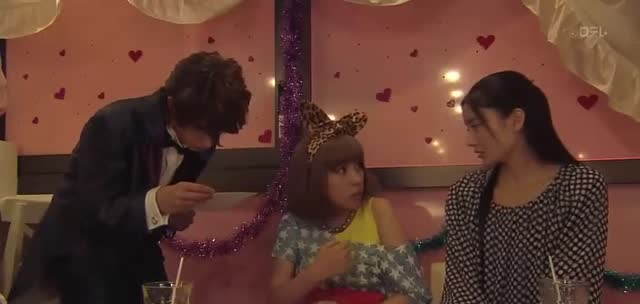
Haruko wanted to act discreetly but is surrounded by her students. She admits she is helping Luca because she hopes to make some money from his doujinshi, and the students call it a rip-off.
ハルコ/ルカ
同人誌で ひと儲け? そう。だから ルカを助けてるんだよ。
Making a killing off a doujinshi? — Yes. That's why I'm helping Luca, you see.
ポール/ハルコ
ぼったくりだぞ ハルコ。 シーッ!
Paul: That's a rip-off, Haruko. — Haruko: Shh!
ボブ
んなこったろうと思ったよ!
I knew it would be something like this!
ボブ/ハルコ
どこ行ったんだ? あの ぼったくり野郎は。
Bob: Where did he go? That rip-off bastard. — Haruko: Huh?
ハルコ
あん?ボブ?ん?ボブ?
Huh? Bob? Hm? Bob?
ハルコ
ん?ボブ ん?ボブ ん?
Hm? Bob? Hm? Bob? Hm?
Speaking notes
ひと儲け
ひと儲け: making a quick profit in one go
「ひと儲け」 = making a profit once; an easy deal. 「ひと〜」 before a verb or noun means "once; a bout of": • 「ひと休み」 = a short rest • 「ひと仕事」 = a job (of work) Haruko's 「ひと儲け? そう」 is an admission made half in jest.
んなこったろうと思った
そんなことだろうと思った: I thought as much; contracted form
「んなこったろうと思ったよ!」 = a colloquial contraction of 「そんなことだろうと思ったよ」. It means "I figured it would be something like that." • 「そんな」 → 「んな」 • 「ことだろう」 → 「こったろう」 With this line, Bob says "I knew it": he had already guessed Haruko's motive. Note: this is an extreme form of rough colloquial contraction, which learners can barely catch the first time.
野郎
〜野郎: rough word for a guy, used as an insult
「ぼったくり野郎」 = that rip-off guy. 「野郎(やろう)」 after a noun is a derogatory term for a man: • 「バカ野郎」 = you idiot It is rough, male speech, and learners should not use it carelessly.
Luca says the person he likes is Ayase Miki, who is always silent and looks angry. Haruko asks how he normally talks to her.
ルカ
綾瀬美貴さん。 いつも無口で 怒った顔してます。
It's Ayase Miki. She's always quiet and has an angry look on her face.
ハルコ/ルカ
あぁ ツンデレ? ツンだけです。 デレは見たことないです。
Haruko: Ah, a tsundere? — Luca: Only the "tsun." I've never seen the "dere."
ルカ/ハルコ
僕の標準語 冷たいからですか? 標準語?
Luca: Is it because my standard language is cold? — Haruko: Standard language?
ルカ
僕の「です」とか「ます」 冷たいと アキバの友達に言われました。
My friends in Akiba told me my "desu" and "masu" sound cold.
ハルコ
やっぱり そうか。
So that's how it is after all.
ハルコ
標準語って 日本人同士でも 冷たく聞こえるの。
Standard language sounds cold even between Japanese people.
ハルコ
ましてや ルカはイケメンだし 外国人だよ。
And what's more, Luca is a good-looking foreigner.
ルカ/ハルコ
それで 美貴さんが緊張して? そういうこと。
Luca: So Miki gets nervous because of that? — Haruko: That's exactly it.
Speaking notes
冷たい「です」「ます」
です/ます is polite but keeps distance, so it sounds cold
[Core knowledge] 「です・ます」 is the "polite style": courteous, but it creates distance. Between Japanese people who are close, they use 「タメ口」 (plain style) or dialect: • です / ます: polite, distant • だ / よ / ね: familiar, casual Luca uses 「です/ます」 with everyone, including the girl he likes, so she feels shut out. Haruko's conclusion 「標準語って日本人同士でも冷たく聞こえる」 is as follows: "standard language" can sound like a "broadcaster's voice," lacking human warmth.
ツンだけです
ツン only, no デレ: splitting the word in half
Luca's assessment of Miki: 「ツンだけです。デレは見たことないです」 = only the "cold," never the "warm." He splits 「ツンデレ」 in two and uses the halves. Linguistically, loanwords and newly coined words can be taken apart and reused, a sign of how flexible Japanese word formation is.
ましてや
ましてや: let alone; all the more so
「ましてや〜(だ)」 = let alone ...; all the more so. Used to add one more layer on top of an existing difficulty: • 「大人でも難しい。ましてや子供には無理だ」 = even adults find it hard, so it is impossible for children Haruko's reasoning: standard language sounds cold; you are also handsome and a foreigner, so she is all the more nervous.
Haruko tells Luca that if he says the confession lines she wrote exactly as written, he will be fine, and she puts a sheet of paper into his hand.
ハルコ
ルカ これ見て。
Luca, look at this.
ハルコ
告白のセリフ。 この通りに言えば大丈夫だから。
Confession lines. If you say it exactly like this, you'll be fine.
ルカ/ハルコ
ほんとに大丈夫ですか? あたしを誰だと思ってんのよ?
Luca: Is it really okay? — Haruko: Who do you think I am?
ハルコ/ルカ
恋愛マスターが ルカのために ひと肌脱いだのよ。 …脱ぐ?
Haruko: The love master has gone out of her way for Luca. — Luca: ...Strip?
ハルコ/ルカ
ルカは 好きって言いたいの。 …好き?
Haruko: Luca wants to say "I like you." — Luca: ...Like?
ハルコ
ルカ 思いきって言っちゃいな!
Luca, go for it and say it!
ルカ
はい。
Yes.
ハルコ/ルカ
思いきって?
Go for it?
ハルコ
頼むよ 30万!
I'm counting on you. 300,000 yen!
Speaking notes
ひと肌脱ぐ
ひと肌脱ぐ: to lend a hand; literally to bare one shoulder
「ひと肌脱ぐ」 = to do one's part (to help someone). Literally "to take off a layer of clothing (bare a shoulder)," it came to mean "to go all out to help." Hearing 「脱ぐ」, Luca takes it for real and thinks he has to undress, blurting out 「…脱ぐ?」: a typical learner's literal reading.
思いきって言っちゃいな
〜いな: casual, encouraging command, from 〜なさい
「言っちゃいな」 = a colloquial contraction of 「言ってしまいなさい」. 「〜いな」 is the colloquial form of 「〜なさい」, with warmth and a nudge: • 「やっちゃいな!」 = go ahead and do it! • 「食べちゃいな」 = go ahead and eat 「思いきって」 = make up one's mind; go for it. Haruko speaks like an older sister or senior encouraging someone younger, completely unlike her "teacher voice."
あたしを誰だと思ってんのよ
あたしを誰だと思ってるの: a self-confident rhetorical question
「あたしを誰だと思ってんのよ?」 = Who do you think I am?! A set pattern: 「Aを誰だと思っている」, a confident rhetorical question meaning "I'm someone important / qualified."
Luca recites the lines Haruko wrote to Miki: "You are working hard, I think."
ルカ
き 君は よく頑張ってると思うよ。
Y-you're doing a good job, I think.
美貴
え?
Huh?
ルカ
きっと夢を叶えられるって お 俺は信じてる。
I-I believe you'll surely make your dream come true.
ルカ/ハルコ
ハルコ先生 あのセリフって…。
Luca: Ms. Haruko, those lines are... — Haruko: ...
ハルコ
教員免許をとろうって 勉強してた時に→
Those are the words my ex-boyfriend said to me
ハルコ
元カレから かけてもらった言葉よ。
when I was studying to get my teaching license.
ルカ/ハルコ
そのまま? そのままでも使えんのよ!
Luca: Just as they are? — Haruko: They work just as they are, you know!
Speaking notes
かけてもらった言葉
かけてもらう: I received kind words from someone
[Giving and receiving verbs] 「元カレからかけてもらった言葉」 = the words my ex-boyfriend said to me (for my benefit). 「言葉をかける」 = to speak to someone; 「かけてもらう」 = I "received" his words. 「もらう」 emphasizes that "I am the one who received," with gratitude for having been encouraged or treated kindly. Had she said 「かけてくれた」, it would emphasize the other person's kindness; with 「かけてもらった」 it emphasizes "I received it."
元カレ
元カレ: ex-boyfriend (元 = former, カレ = boyfriend)
「元カレ(もとカレ)」 = ex-boyfriend. 「元」 = former, and 「カレ」 is a shortening of 「彼氏」. The opposite is 「今カレ」 (current boyfriend), and for women the term is 「元カノ」.
使えんのよ
使えんのよ: colloquial contraction of 使えるのよ
「使えんのよ!」 = a colloquial contraction of 「使えるのよ」. 「える」 → 「えん」 is a very common change in speech: • できるの → できんの • 食べられるの → 食べられんの Haruko's logic: "a good line works for any person; just use it as is."
Key vocabulary
夢を叶える ゆめをかなえる
To make a dream come true.
教員免許 きょういんめんきょ
Teaching license.
元カレ もとカレ
Ex-boyfriend.
そのまま
As it is; unchanged.
言葉をかける ことばをかける
To speak to (someone); to say a word of encouragement.
Luca keeps reciting the script to Miki: don't give up, I'll stay with you. The words sound moving, but Miki's face grows more and more grim.
ルカ
あ 諦めるなよ。 俺がとことん付き合ってやるから。
Hey, don't give up. I'll stick with you all the way.
ルカ
とくに夢はないけど。
Not that I have any particular dream.
ルカ/ハルコ
あれ? ほら。
Luca: Huh? — Haruko: Go on.
ルカ
その代わりって言ったら 何だけど→
It may sound strange to call it "in return," but...
ルカ
もし夢を叶えたら 今度 俺の夢を叶えてくれないか?
if you make your dream come true, would you make mine come true next time?
ルカ/ハルコ
縛るつもりはない。 ルカ君…。
Luca: I don't intend to tie you down. — Haruko: Luca...
ハルコ
いける!
That's it!
ルカ
俺と付き合って欲しい。
I want you to go out with me.
Speaking notes
付き合ってやるから
〜てやる: rough, masculine version of あげる
[Giving and receiving verbs] 「付き合ってやるから」 = I'll stay with you to the end, so. 「〜てやる」 is the masculine or rough version of 「〜てあげる」, with confidence and a touch of a protector's swagger: • 「俺がやってやる」 = I'll do it for you These are the "ex-boyfriend's" lines, and in male speech they come across as "gentle forcefulness." But coming from Luca, a foreign student who always speaks in 「です/ます」, they sound out of place: his polite-style habit is completely overwhelmed by this masculine tone.
〜てくれないか
〜てくれないか: a sincere, masculine way to ask a favor
[Giving and receiving verbs] 「叶えてくれないか?」 = Would you make it come true (for me)? The negative-question form of 「〜てくれる」 is a masculine request, closer than 「〜てください」 and more polite than 「〜てくれる?」: • 叶えてください: (polite) • 叶えてくれる?: (peer) • 叶えてくれないか?: (masculine, sincere) This is a dignified way to propose love in Japanese.
縛るつもりはない
〜つもりはない: having no intention of doing it
「縛るつもりはない」 = I have no intention of tying you down. 「〜つもりはない」 is a clear denial of intention and weighs more than plain 「〜ない」. • 「騙すつもりはなかった」 = I never meant to deceive you