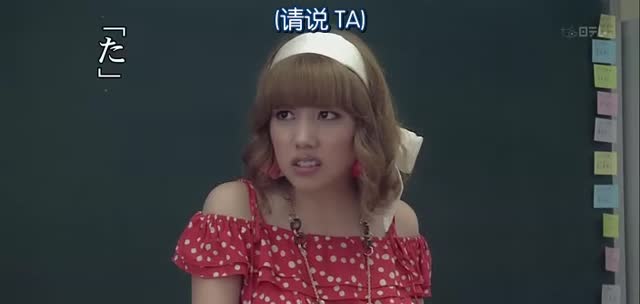
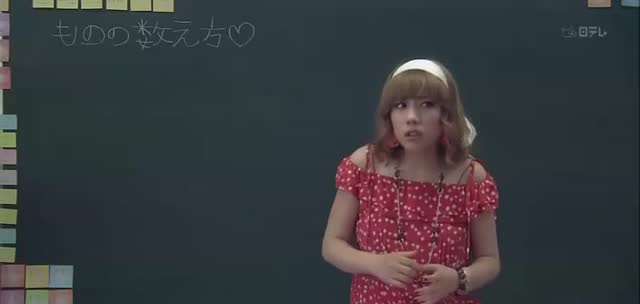
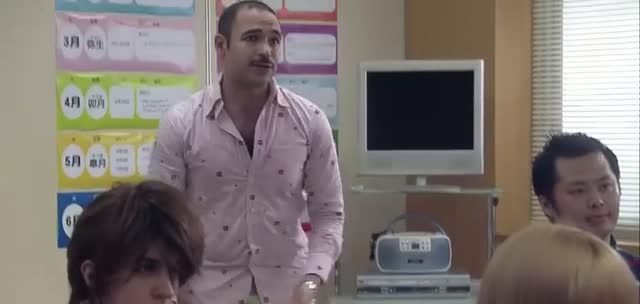
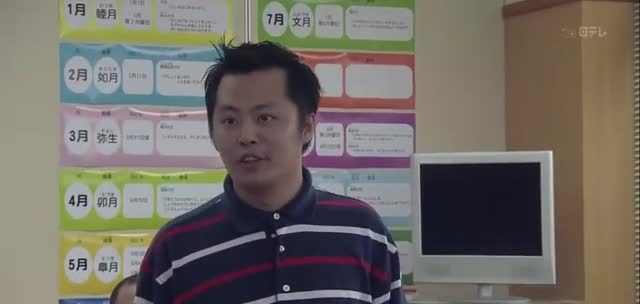
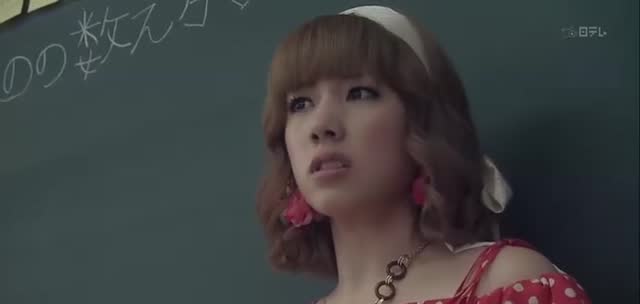
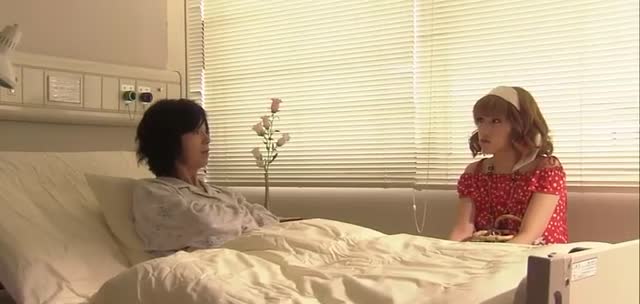
This episode has 55 conversation scenes: talking to a foreigner on a bus, a self-introduction class, a lesson on counters, expressions used in a ramen shop and a sushi shop, and how to write the kanji 「鮪」. The focus is on the way Japanese people drop particles when talking to foreigners, and on counters such as 「一匹」 and 「一頭」.
Language highlights
「〜ってもんじゃない」(it's not simply a matter of...)
「〜と数えるんだ」(you count it as...)
「〜わけにいかない」(can't do it, for reasons of duty or position)
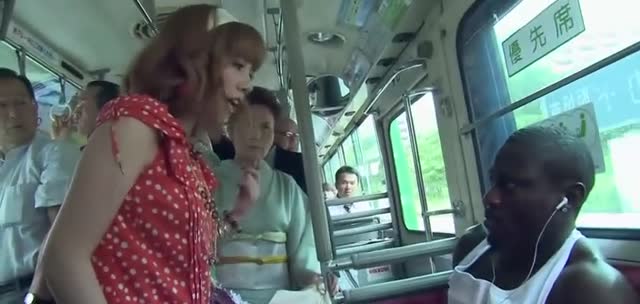
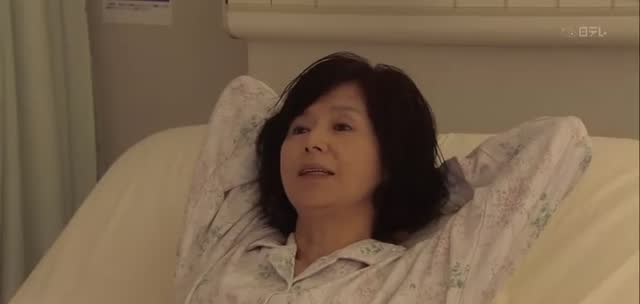
On a bus, Haruko Kano sees a foreign passenger, Bob, wearing earphones in a priority seat while an old woman with heavy bags stands next to him. She speaks to him in simplified Japanese to ask him to turn the volume down.
ハルコ
すいません。
Excuse me.
ボブ
ホワッツ?
What's?
ハルコ
耳 シャカシャカ 音 小さく 分かる?
Ear, shaka-shaka. Sound, small. Understand?
ハルコ
おばあちゃん 荷物 重い あなた 立つ。
Granny, luggage, heavy. You, stand.
ハルコ/ボブ
おばあちゃん 座る。いい? ノゥ~。
Granny, sit. OK? -- No~.
おばあさん/ハルコ
いいわよ いいわよ。おばあちゃんは黙っといて。
It's fine, it's fine. -- Granny, you stay out of this.
ボブ
あの…。エクスキューズミー。
Um... Excuse me.
Speaking notes
耳 シャカシャカ 音 小さく 分かる?
Dropping every particle: the "Japanese for foreigners" trap
This is the first example of what the title means: "the Japanese that Japanese people don't know." When Haruko talks to a foreigner, she strips out all the particles (が・を・に・は) and leaves only bare nouns and dictionary-form verbs: 「耳が シャカシャカ 音を 小さくして くれませんか」 becomes 「耳 シャカシャカ 音 小さく 分かる?」 Japanese speakers often do this to foreigners without thinking, assuming that "simple = easy to understand." In fact particles are exactly the skeleton that learners need, so removing them makes the sentence harder to follow. Also, 「あなた」 used with a stranger sounds distant and a little condescending, and with the blunt 「立つ」 the politeness level is very low.
黙っといて
〜ておいて contracted to 〜といて
「黙っといて」 = 「黙っておいて」. In casual speech 「〜ておく」 is often shortened to 「〜とく」, and the request/command form becomes 「〜といて」. • やっておく → やっとく • 見ておいて → 見といて The core meaning of 「〜ておく」 is "do it in advance / leave it that way," so 「黙っといて」 has the feel of "just keep your mouth shut and stay put". It is softer than 「黙れ」 (Shut up!), but it is still an order. The 「いいわよ」 at the start is feminine speech: 「〜わ」 softens the tone and 「よ」 informs the listener.
Key vocabulary
シャカシャカ
Onomatopoeia for the faint tinny sound leaking from earphones.
Haruko assumes the foreigner is ignoring the rules by not giving up his seat, and lectures Bob with a Japanese proverb. Bob can't follow and catches only one sound.
ハルコ
英語で ベラベラまくし立てたら→
If you think that rattling off a bunch of English at me
ハルコ
びびって引き下がるとでも 思ってんの!?
is going to scare me into backing down...!?
ハルコ
なんか文句あるんだろうけど→
I'm sure you have some kind of complaint,
ハルコ
おばあちゃんに席を譲るぐらい どうってことないじゃない!
but giving up your seat for an old lady is no big deal, is it!
ハルコ
っていうか それが日本の ルールってもんじゃないの?
Besides, isn't that the rule in Japan?
ハルコ
あんたもさ 日本に来たなら 日本のルール 受け入れなさいよ!
You too, you know. If you come to Japan, accept Japan's rules!
ハルコ
『郷に入っては郷に従え』よ!
"When in Rome, do as the Romans do"!
ボブ
ゴウ?
Go?
ハルコ
郷は郷よ!!
郷 is 郷!!
Speaking notes
〜ってもんじゃないの
〜ってもんじゃないの: using "common sense" to pressure someone
「〜というものだ」 presents your own view as "obvious common sense" in order to press the other person. 「それが日本のルールってもんじゃないの?」 = "Isn't that the rule in Japan?": a personal opinion dressed up as something "everybody knows." • 「ってもん」 is a casual contraction of 「というもの」 • The sentence-final 「じゃないの?」 is a rhetorical question: she isn't really asking, she is applying pressure Notice the string of rough colloquialisms before it: 「びびって」, 「ベラベラ」, 「まくし立てる」, 「どうってことない」.
引き下がる
引き下がる: to back down after being pressed
「引き下がる」 = to back off, to step aside, to stop insisting. It is mostly used when someone gives up arguing because they were intimidated or persuaded: 「そう簡単には引き下がらない」 = "I won't give up that easily." 「びびって引き下がる」 = to get scared and back down. 「びびる」 is colloquial for "to get scared / lose one's nerve."
郷に入っては郷に従え
Proverb: when in Rome, do as the Romans do
「郷に入っては郷に従え」 = when you go to a place, follow the customs of that place. • 「郷(ごう)」 = a village, a locality (an old reading, which is why Bob hears the English word "go") • 「入っては」 = 「入ったならば」, a classical-style conditional • 「従え」 is the imperative form Bob's 「ゴウ?」 is a mishearing, and Haruko's answer 「郷は郷よ!!」 is a circular answer that does not actually explain the word.
Key vocabulary
まくし立てる まくしたてる
To talk on and on, to fire off words in a rapid stream.
引き下がる ひきさがる
To back down, to give way.
文句 もんく
Complaint, grievance.
席を譲る せきをゆずる
To give up one's seat.
受け入れる うけいれる
To accept, to take in.
郷 ごう
Village, locality. In the proverb 「郷に入っては郷に従え」 = "When in Rome, do as the Romans do."
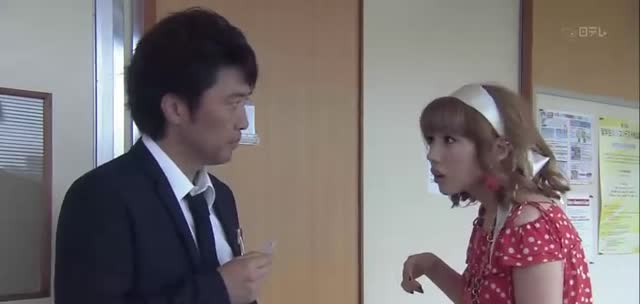
Haruko finds the school Kobun Gakuin using a business card. In the staff room, Shibuya and Katori are talking about the new teacher who arrived today and was late on her first day.
渋谷
初日から遅刻か? ふざけた奴がいるもんだよ。
Late on the first day? Some people really have nerve.
鹿取
でも良かったです。 何が?
But it's actually a good thing. -- What is?
鹿取
新しい先生が来てくれるお陰で 他の先生方の負担が減りますから。
With a new teacher coming to help us, the other teachers' workload will go down.
生徒
やさしいよ! ああ!そんな…。
She's kind, you know! -- Ah! Not like that...
生徒
やさしいよ! カトリーヌ先生はよ!
She's kind! Ms. Catherine is!
鹿取
カトリーヌじゃなくて鹿取です。
It's not Catherine, it's Katori.
Speaking notes
来てくれるお陰で
来てくれる + お陰で: the giving/receiving perspective
The 「くれる」 here is a giving/receiving verb, and the viewpoint is "our side." 「新しい先生が来てくれる」 = the new teacher is kind enough to come (and do this for us). • 「来る」 merely describes that someone came • 「来てくれる」 = they came, and it is a favor to us; the speaker is on the receiving end and sounds grateful Add 「お陰で」 ("thanks to") and the whole sentence thanks a new teacher the speaker hasn't even met. Meanwhile Shibuya, in the previous line, criticizes directly with 「遅刻か」. The same event is seen as a favor by Katori (through 「くれる」) and as a fault by Shibuya (through 「ふざけた奴」): the difference in their stances is carried entirely by the grammar.
〜もんだ
〜もんだ: "you do get people like that"
Sentence-final 「〜ものだ/〜もんだ」 expresses amazement: "there really are people who..." 「ふざけた奴がいるもんだよ」 = "Some people really are that irresponsible", half surprised and half sarcastic. Compared with the plain 「ふざけた奴がいる」 ("there is an irresponsible person"), it adds a feeling of "who would have thought" and heartfelt wonder. 「ふざける」 means "to joke around, to not take things seriously," and 「ふざけるな!」 = "Don't mess with me!" (an angry reprimand).
Key vocabulary
初日 しょにち
First day.
遅刻 ちこく
Being late (for work, school, etc.).
負担 ふたん
Burden, load.
先生方 せんせいがた
The teachers (「方」 is the respectful counterpart of 「達」).
Haruko is chased down a hallway by a group of foreign students and runs screaming into the school, where Takasu stops her and treats her as an intruder.
ハルコ
警察!警察に電話して!
Police! Call the police!
ハルコ
来ないでよ!それ以上 近づいたら 不法侵入で訴えるよ!
Don't come near me! If you get any closer, I'll sue you for trespassing!
ボブ
俺 遅刻かよ。
Great, now I'm late.
鷹栖
大丈夫だ ボブ 早く教室に入れ。
It's all right, Bob. Get to your classroom quickly.
ハルコ
いや…あの…日本語しゃべるんだ。
No, um... you speak Japanese...
鷹栖
部外者は出てってくれ。不法侵入で訴えるぞ。
Outsiders, please leave. I'll sue you for trespassing.
ハルコ
いやいや…教師教師。
No, no... teacher, I'm a teacher.
Speaking notes
訴えるよ/訴えるぞ
訴えるよ vs. 訴えるぞ: the sentence-final particles よ and ぞ
Haruko uses 「よ」 and Takasu uses 「ぞ」 with the very same 「訴える」: one soft, one hard. • 「〜よ」: tells the listener your own judgment; neutral to soft (common in women's speech) • 「〜ぞ」: masculine speech that carries a warning or threat, like "If you don't leave, I really will go after you" So Takasu's 「訴えるぞ」 is not a mere statement; he is treating her as an intruder who needs to be scared off.
日本語しゃべるんだ
〜んだ as a realization
「〜んだ」 here does not explain anything; it expresses "oh, so that's how it is." After shouting in panic all the way here, Haruko suddenly realizes at this moment that they could understand every word. 「日本語しゃべるんだ」 = "Oh, so you speak Japanese." Also: 「しゃべる」 is the colloquial word for "to talk"; in writing or formal speech you use 「話す」.
Key vocabulary
不法侵入 ふほうしんにゅう
Trespassing (on private land or buildings).
訴える うったえる
To sue; to appeal to.
部外者 ぶがいしゃ
Outsider, a person not connected to the organization.
教師 きょうし
Teacher (more formal and more of a job title than 「先生」).
Takasu asks Haruko who she is. She pulls out the business card of the principal, Akimoto, and says she was invited; Takasu tells her the principal was hospitalized yesterday.
ハルコ
秋元先生に 頼まれてきたんだって。ほら。
Ms. Akimoto asked me to come. Look.
鷹栖
秋元先生は?
Where is Ms. Akimoto?
鷹栖
校長なら 昨日 入院した。 はっ!?
If you mean the principal, she was hospitalized yesterday. -- What!?
ハルコ
入院って 来週じゃなかったの?
Hospitalized? Wasn't that next week?
渋谷
早まったんだ。 え!?
It was moved up. -- What!?
鹿取
あっいた!なんなんだよ 君は!
Ah, there you are! Who on earth are you!
ハルコ
いやいや…今日から この予備校で働く…。
No, no... from today I'm working at this cram school...
鷹栖
予備校?
Cram school?
Speaking notes
頼まれてきた
頼まれてきた: passive + 〜てくる
「頼まれて」 is the passive form, so the viewpoint is that of the person who was asked. 「秋元先生に頼まれてきた」 = "Ms. Akimoto asked me to come," meaning "I was invited, I didn't just barge in." Using a passive sentence rather than 「私は来た」 shifts the responsibility onto the principal, a typical self-protective way of putting it. 「〜てくる」 expresses coming with some cause or state attached: 頼まれてくる = come because you were asked; 怒って帰ってくる = come back angry.
〜じゃなかったの?
〜じゃなかったの?: checking against what you remember
「〜じゃなかったの?」 = "I thought it was... am I wrong?" The speaker already has an impression (the hospital stay was next week) and asks about it when reality doesn't match. The past form 「〜かった」 here does not refer to the past; it is "a recollected understanding." The speaker recalls what they heard before and compares it with reality. Similar: 「今日、休みじゃなかったっけ?」 = "Isn't today a day off?" 「早まった」 is the past tense of 「早まる」, "it got moved earlier"; things moved up by themselves, with no human subject.
Key vocabulary
入院 にゅういん
Hospitalization. The opposite is 「退院(たいいん)」.
校長 こうちょう
Principal (of a school).
予備校 よびこう
Cram school, a school for preparing for entrance exams (for Japanese students).
Takasu tells Haruko that this school teaches foreigners, that it is a Japanese-language school. Haruko had assumed it was a cram school for entrance exams and refuses to believe him.
鷹栖
ここは外国人に 日本語を教える日本語学校だ。
This is a Japanese-language school that teaches Japanese to foreigners.
ハルコ
プッ!またまた~。
Ha! Oh, come on~.
ハルコ
その真顔ね 超ウケますよ。ちょっとどいて下さい。
That straight face of yours is hilarious. Please step aside.
ハルコ
ん!?
Huh!?
ハルコ/鷹栖
うそ…! うそじゃない。
No way...! -- It's not a lie.
ハルコ/鷹栖
ほんとに? ほんとだ。
Really? -- Really.
ハルコ
ええ~っ!日本語学校!?
Whaaat~! A Japanese-language school!?
Speaking notes
またまた~
またまた〜: "Oh, stop it"
「またまた」 = "Oh, come on / you're kidding." It is the reaction of laughing off something outrageous that someone just said. Literally "again and again," in the sense of "you're joking again." The tone is light and usually comes with a laugh, so Haruko is assuming he's teasing her. The next line 「超ウケますよ」 is young people's speech: 「超」 = very, 「ウケる」 = to find something funny / to go over well. Note that she uses the 「ます」 form but mixes in 「超」: her polite speech is half-baked.
日本語学校
日本語学校 is not 予備校
「日本語学校」 = a school that teaches Japanese to foreigners; 「予備校」 = a cram school that helps Japanese students prepare for university entrance exams. The two words sound nothing alike, but Haruko took 「教師」 for granted as the latter, presuming that "Japan = teaching Japanese people."
Key vocabulary
日本語学校 にほんごがっこう
Japanese-language school (for foreigners).
真顔 まがお
Straight face, serious expression.
ウケる
To be funny, to go over well (colloquial).
どく
To move out of the way (「どいて」 is the request form).
Takasu asks Haruko whether she really came because she mistook this place for a cram school. Haruko says that when anyone is asked to "be a teacher," they think of tutoring and cram schools; Katori, flipping through a magazine, recognizes her as a "charisma shop clerk."
鷹栖
ほんとに予備校と 勘違いして来たのか?
Did you really come here because you thought it was a cram school?
ハルコ
いや…普通「先生を やって欲しい」って言われたら→
No... normally when someone says "I'd like you to be a teacher,"
ハルコ
家庭教師とか塾とか予備校じゃん!?
you think of private tutoring or cram school or prep school, right!?
鷹栖/渋谷
じゃあ 日本語教師の経験は? ゼロでしょ。
Then, do you have any experience as a Japanese teacher? -- Zero, right.
鷹栖/ハルコ
帰っていいぞ。 はあ!?
You can go home. -- Huh!?
ハルコ/鹿取
ちょっ待ってよ! あの!
Hey, wait a minute! -- Excuse me!
鹿取
カリスマ店員なんですよね?
You're a "charisma clerk," aren't you?
ハルコ
…だったよ。やめてきたんだから。
...I was. Because I quit, didn't I.
Speaking notes
〜て欲しい
〜て欲しい: wanting someone to do something for you
「やって欲しい」 = "I want you to do it (for me)." The speaker's "wish" is the subject, and the one carrying out the action is the other person. It belongs to the same system as the giving/receiving verbs: • 〜てくれる: the other person did something (in my favor) • 〜てもらう: I asked the other person / I received the action • 〜て欲しい: not done yet; I want the other person to do it Akimoto only said 「先生をやって欲しい」, and Haruko filled in "cram-school teacher" on her own.
やめてきたんだから
やめてきたんだから: quit and then came
「やめてきた」 = "I quit and came here." Here 「〜てくる」 means "finish or settle one thing, and then arrive here," which gives the sense of "coming with the result in hand" that 「やめた」 lacks. 「〜んだから」 stresses the reason and leaves no room for argument: "I've already quit, haven't I!"
Key vocabulary
勘違い かんちがい
Misunderstanding, mix-up.
家庭教師 かていきょうし
Private tutor.
塾 じゅく
Cram school, an after-school private school.
カリスマ店員 かりすまてんいん
"Charisma shop clerk," once a buzzword in Japan for star clerks in fashion stores who attract customers.
Takasu presses Haruko on why she came here. Haruko says it's too late for her to go home now and that she has various reasons, but she is evasive.
ハルコ
今さら帰るわけに いかないんだって!
At this point I can't just go home!
ハルコ
こっちにも色々事情があんのよ!
I have my reasons too, you know!
鷹栖
どんな事情だ?
What reasons?
ハルコ
それは…ね→
Well... that is...
ハルコ
とりあえず見してみなさいよ。
Anyway, just let me see it (the teaching material).
Speaking notes
帰るわけにいかない
帰るわけにいかない: cannot, for reasons of obligation
「〜わけにはいかない」 = you can't do it because of reason, position, or obligation. It is different from 「帰れない」 (physically impossible): • 帰れない: the last train is gone, you can't leave • 帰るわけにいかない: you are able to leave, but it would not be right to do so 「今さら」 = "at this point," often with a sense of helplessness that it is too late to turn back.
見してみなさいよ
見して: casual speech + 〜なさい
「見して」 is a colloquial variant of 「見せて」 (the 「せ」 at the end weakens to 「し」), with a casual, "gal"-like feel. The following 「みなさい」 is 「〜てみなさい」 = the command form of "try it." She is asking to be shown the teaching materials, but she uses a commanding tone with 「みなさいよ」: she is in the position of making a request, but speaks as if talking down to someone. 「〜なさい」 is a command used toward juniors or children, so it sounds like a teacher addressing a student, which is highly rude toward a senior like Takasu.
Key vocabulary
今さら いまさら
At this point (it's too late to...).
事情 じじょう
Circumstances, reasons, personal circumstances.
とりあえず
For now, first of all, anyway.
〜わけにはいかない
Can't (do something) because of reasons of duty or position.
Takasu hands Haruko the Japanese textbook. She glances at it and says it is too easy, elementary-school level, and that she has a high school teaching license.
ハルコ
な~んだ。これ 小学生レベルじゃん。
Oh, come on. This is elementary-school level.
ハルコ
私ね こう見えても 高校の教員免許 持ってるんで~。
I'll have you know, I may not look it, but I have a high school teaching license~.
鷹栖
んなもん ここじゃ 何の役にも立ちません!
That kind of thing is no use at all here!
鷹栖
授業を見てから言ってくれます!?
Could you say that after you've watched a class!?
Speaking notes
こう見えても
こう見えても: "I may not look it, but..."
「こう見えても〜」 = "Though I may not look like it..., actually...", introducing a boast that doesn't match one's appearance. Haruko is flashily dressed, so she adds "I do have a teaching license." The 「んで」 in 「持ってるんで~」 is the casual form of 「ので」, and the drawn-out ending is a relaxed, young-people's way of speaking.
役に立つ
役に立つ: to be useful
「役に立つ」 = to be useful. Its negative is 「役に立たない」 = "useless." Takasu's 「何の役にも立ちません!」 uses the pattern 「何の〜にも+negative」 for emphasis: "of no use whatsoever." Note that he uses 「ません」 rather than 「ない」, which sounds stiffer than Haruko's casual speech: there is impatience under the polite shell.
Key vocabulary
レベル
Level (as in the English word).
教員免許 きょういんめんきょ
Teaching license.
役に立つ やくにたつ
To be useful, to come in handy.
授業 じゅぎょう
Class, lesson, instruction.
んなもん
Casual contraction of 「そんなもの」 ("that kind of thing").
Haruko stands at the front of the classroom full of foreign students and introduces herself, still in the same simplified Japanese she used on the bus.
ハルコ
あたし…嘉納ハルコ。 みんな よろしくね!
I... Haruko Kano. Everyone, nice to meet you!
ハルコ
あたし ハルコ 先生 分かる?
I, Haruko, teacher. Understand?
ジャック
分かってますんで 授業を進めてください。
We understand, so please go on with the lesson.
ハルコ
へ? 全員 簡単な日常会話は出来る。
Huh? -- Everyone can handle simple everyday conversation.
ハルコ
先に言ってよ!
You should have told me first!
Speaking notes
分かってますんで
分かってますんで: polite form + casual んで
「分かってますんで」 mixes the polite style with the casual 「んで」. 「んで」 is a casual contraction of 「ので」 and originally belongs to speech among friends; here it follows 「ます」 and is followed by 「授業を進めてください」, so a little casualness sits inside a polite frame. This is the most common "register mismatch" for learners: a Japanese teacher has to teach not only vocabulary but also which level of speech to use on which occasion.
簡単な日常会話は出来る
簡単な日常会話は出来る: は as contrast
「出来る」 = can, to be able to (ability). The 「は」 in 「〜は出来る」 marks contrast or limitation: "simple everyday conversation, yes (we can do that)," implying "but maybe not anything harder." In 「先に言ってよ!」, 「〜てよ」 is a request with a note of reproach: "you should have told me earlier."
Key vocabulary
授業を進める じゅぎょうをすすめる
To move the lesson forward, to continue the class.
Haruko tells the class to ask anything about how to count things. Diana asks first, about how to count straws.
ハルコ
じゃあ ものの数え方について 質問のある人。
Now then, anyone with a question about how to count things?
ハルコ
先生が何でも教えてあげます。
I'll teach you anything.
ダイアナ/ハルコ
ストローは? 立って言って。
What about straws? -- Say it standing up.
ダイアナ/ハルコ
た。 立って言って。
Ta. -- Say it standing up.
ダイアナ/ハルコ
た! た?
Ta! -- Ta?
ダイアナ
ああ~!あ~っと…。
Ahh~! Um...
ハルコ
立ち上がって言って下さい。
Please stand up and say it.
ダイアナ
ストローは「一個」?
Is a straw 「一個」?
ハルコ
ううん。ストローは 「一本」って数えるの。
No. A straw is counted as 「一本」.
ハルコ
細くて長いものは 「本」って数えるのよ。
Things that are thin and long are counted with 「本」.
Speaking notes
教えてあげます
教えてあげます: a favor from the speaker's side
「教えてあげます」 is an auxiliary use of the giving verb 「あげる」, and the viewpoint is that of the giver. • 教える: simply "to teach" • 教えてあげる: I "do you the favor of" teaching; the speaker is placing themselves above, giving the other person a favor In Japanese, 「〜てあげる」 cannot be used casually toward superiors or customers, because it sounds like a condescending handout. Here Haruko uses it toward her students, which reveals that she sees teaching as "I'm bestowing knowledge on you" rather than "I'm serving you." The proper ways to say it are 「何でも教えます」 (plain) or 「お教えします」 (humble).
立って/立ち上がって
立つ vs. 立ち上がる
Both words involve "standing," but the picture is different. • 立つ: to stand (can describe either a state or an action) • 立ち上がる: the action of rising from a seated position The first time, Haruko says 「立って言って」 ("say it standing"), and the student doesn't react. She then switches to 「立ち上がって言って下さい」. Also, she adds 「下さい」 after 「言って」, softening a command into a request.
細くて長いものは「本」
Things that are thin and long: the counter 本
「本」 is the counter for "long, thin objects": 鉛筆, ペン, 傘, ストロー, 木, 道路, 電車, and so on. The reading changes with the number before it: 一本(いっぽん)・二本(にほん)・三本(さんぼん). Japanese counters are classified by shape and nature, so a straw is 「一本」, not 「一個」.
Key vocabulary
数え方 かぞえかた
How to count (things).
ストロー
Straw (the drinking kind).
立ち上がる たちあがる
To stand up, to rise to one's feet.
助数詞 じょすうし
Counter (a word attached to a number to count things).
In class, Wang points out that in his country long things such as snakes and rivers share one counter, and asks how a snake is counted in Japanese.
王
は~い! なに?
Yes~! -- What is it?
王
じゃあ 蛇も「一本」か?
Then is a snake also 「一本」?
ハルコ
蛇は「一匹」。生き物だからね。
A snake is 「一匹」. Because it's a living creature.
王
中国 長いもの 全部「条」って数えるよ。川も蛇も。
In China, all long things are counted as 「条」. Rivers, snakes.
ハルコ
「条」…かも しれないけど→
It may be 「条」... but
ハルコ
日本人は生き物か そうじゃないかで区別するの。
Japanese people make the distinction by whether it's a living thing or not.
生徒
犬は「一匹」ですが 象や馬は「一頭」と数えます。
A dog is 「一匹」, but elephants and horses are counted as 「一頭」.
ハルコ
そう!他に大きさで 数え方が変わるもの知ってる人!
Right! Who else knows things whose counter changes depending on size!
Speaking notes
〜かもしれないけど
〜かもしれないけど: concede, then make your point
「〜かもしれないけど」 = acknowledge that the other person may be right, then turn to your own point. It is a typical Japanese "soft landing" expression: instead of saying "you're wrong," you say "that may be so, but..." Haruko's 「かも しれないけど→」 first accepts Wang's point (about 「条」) and then explains the Japanese rule. Note that the 「→」 at the end of her line in the subtitles is a continuation mark: the sentence is unfinished and the next subtitle carries on.
そうじゃないか
〜か〜かで: sorting by "A or B"
「生き物か そうじゃないかで区別する」 = to distinguish by "is it a living thing or not." Japanese often uses the pattern 「AかBかで〜」 to mean "on the basis of A or B." • 「好きか嫌いかで決める」 = to decide based on whether you like it or not 「そうじゃない」 is a contextually shortened 「そうではない」, meaning "it isn't (a living thing)." The rule here: 匹 = small animals (犬, 猫, 魚, 虫, 蛇); 頭 = large animals (象, 馬, 牛). It is easy to memorize in one sentence, but the boundary is actually blurry.
そう!
そう!: the teacher's "that's right!"
「そう!」 = "Yes, exactly!" It is the teacher's standard reaction when a student gets it right, with rising and drawn-out intonation. Note the tone: this is not the polite 「そうです」 but the plain-form 「そう!」, which carries the excitement and closeness of the classroom.
Key vocabulary
蛇 へび
Snake.
生き物 いきもの
Living thing, animal.
区別 くべつ
Distinction, differentiation.
象 ぞう
Elephant.
頭 とう
Counter for large animals. 「一頭」.
匹 ひき
Counter for small animals (and fish, insects). 「一匹」.
The class gets livelier, and the students ask how to count odd things around them, such as bras and mobile suits.
生徒
ブラジャー。 ブラジャー…。
Brassiere. -- Brassiere...
生徒/ハルコ
AとかBとか。 いや…それはサイズでしょ。
Like A or B or... -- No... that's the size, isn't it.
ルイ
モビルスーツは?
What about mobile suits?
ハルコ/鷹栖
モ モビル…。 モビルスーツは一機だ。
M-Mobile... -- Mobile suits are 「一機」.
ルイ
じゃあ 人間も「一機」?
Then are people also 「一機」?
ハルコ
いや…人間は「一人 二人」。 だってモノじゃないじゃん。
No... people are 「一人, 二人」. Because they're not things, are they.
Speaking notes
モノじゃないじゃん
モノじゃないじゃん: casual じゃん
「〜じゃん」 is the casual form of 「〜じゃないか」, a confident assertion that draws the listener in: "you know this already, right?" 「モノじゃないじゃん」 = "they're not objects, right?" Haruko's speech is very "gal"-like, so she keeps using 「じゃん」. Classroom language and talk with friends are mixed together. Note that she just said 「人間は一人 二人」: 「一人(ひとり)」 and 「二人(ふたり)」 are special readings (not 「いちにん」, 「ににん」).
モビルスーツは一機だ
モビルスーツは一機だ: the counter 機
「一機」 is used to count aircraft, machines, and manufactured equipment. 「飛行機は一機、二機」, 「戦闘機」, and for robots 「ロボットは一体」. Here Takasu answers with a cool 「〜だ」, stepping in to finish Haruko's sentence as a flat assertion. By the way: people are counted with the 「人(にん)」 series, and things depend on their shape. The two systems must not be mixed, which is the most important principle of counters.
Key vocabulary
ブラジャー
Brassiere.
サイズ
Size.
モビルスーツ
Mobile suit (the humanoid weapon in the Gundam series).
The students argue over whether a person is counted as 「一匹」, and Elaine produces 「男一匹」 from her book as proof. Takasu can't watch any longer and starts explaining how tuna are counted.
エレーン
違う!人間は一匹です!
Wrong! A person is 「一匹」!
エレーン
ここに書いてあります!「男一匹」って!
It says so right here! "男一匹"!
生徒/ハルコ
ほんとだ…。 じゃあ マグロも「一匹」?
You're right... -- Then is tuna also 「一匹」?
ハルコ
マグロは確か「一本」じゃ…。
I'm pretty sure tuna is 「一本」...
鷹栖
マグロは その形によって いくつか数え方がある。
Tuna has several counters depending on its shape.
鷹栖
海を泳いでる時は「一匹」。
When it's swimming in the sea, it's 「一匹」.
鷹栖
だが釣り上げると「一本」。
But once it's hooked and pulled up, it's 「一本」.
Speaking notes
男一匹
男一匹: a man all on his own
「男一匹(おとこいっぴき)」 is a fixed expression, almost like an idiom: a proper, full-fledged man. Here 「匹」 does not "count an animal"; it conveys a bold, slightly self-mocking "one man (standing on his own)", as in 「男一匹、命をかける」. Elaine saw an example in her book where a person is counted with 匹, and used it to argue against Haruko. This is typical of foreign students "learning Japanese literally": an idiom is a set usage and can't be treated as a rule.
形によって
形によって: depending on the shape
「AによってB」 = B differs depending on A. 「形によって数え方がある」 = there are different counters depending on the shape. • 「人によって考えが違う」 = ideas differ from person to person • 「場合によっては」 = depending on the case It must be followed by a predicate of change, difference, or variety. It is a very common framework in explanatory writing.
釣り上げると
釣り上げると: 〜と as a natural consequence
「〜と」 expresses a natural result: "whenever A happens, B follows." 「釣り上げると一本」 = as soon as it's pulled up, it becomes 「一本」. The difference from 「〜たら」 and 「〜ば」: in a 「と」 sentence there is almost no will of the speaker; it is an objective description of "that's just how things go."
Takasu explains that as tuna goes from the catch to the market to the supermarket, the counter changes with each cut. The students nod along.
鷹栖
それを市場で切り分けると「一丁」になり→
When it's cut up at the market, it becomes 「一丁」,
鷹栖
さらに切り分けたものが「一塊」 という意味で「一塊」。
and the pieces cut from that are 「一塊」, in the sense of "a chunk."
鷹栖
それがスーパーで パック詰めされると→
Then when it's packed at the supermarket,
鷹栖
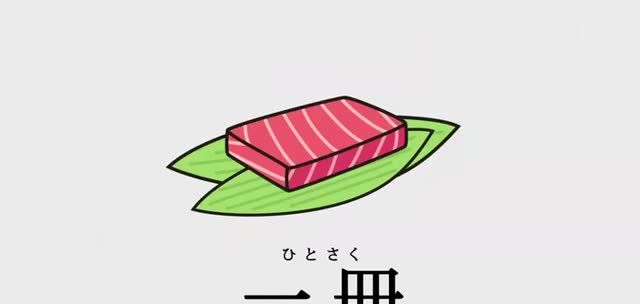
短冊に似てることから「一冊」。
it looks like a tanzaku strip, so it's 「一冊」.
鷹栖
そして人の口に入る時は「一切れ」と数えるんだ。
And when it goes into someone's mouth, it's counted as 「一切れ」.
生徒たち
へえ~。
Wow~.
生徒たち
へえ~。
Wow~.
生徒
知らなかったのですか?
Didn't you know?
Speaking notes
〜と数えるんだ
〜と数えるんだ: the explaining んだ
The 「〜んだ」 ending carries an "explaining" tone: I am telling you how it works. Takasu ends with 「〜んだ」 to wrap up the whole explanation in an authoritative "this is the rule" voice. • 「〜です」: a simple statement • 「〜んです」: carries an explanatory feel, "you may not know this, so let me tell you"
切り分ける
切り分ける: to cut into portions
「切り分ける」 = to cut one thing into several portions. It is the compound verb 「切る+分ける」. • 「ケーキを切り分ける」 = to cut a cake into pieces The counters here follow the stages of processing the fish: 匹 (live fish) → 本 (whole fish) → 丁 (cut into big blocks) → 塊 → 柵 → 切れ. In the subtitles 「一塊」 and 「一冊」 appear to stand for 「ひとかたまり」 and 「ひとさく(柵)」. 「柵」 is a rectangular block of fish for sashimi, named for its resemblance to a 「短冊」 (a tall, narrow strip of paper). The most interesting point of the lesson: for the very same object, the counter changes just because its "state" has changed.
Key vocabulary
市場 いちば
Market.
切り分ける きりわける
To cut up, to divide.
短冊 たんざく
A narrow strip of paper used for writing poems; a block of sashimi fish (「柵」) is named for its similar shape.
Haruko, upstaged by Takasu, is so annoyed that she tries to throw him out. Paul takes the chance to ask how to write the kanji for tuna, and Haruko confidently writes it on the board.
ハルコ
あなた 余計なこと言うから。 出てってくれません?
It's because you say needless things. Would you mind leaving?
鷹栖
どうなっても知らね~ぞ。
Don't blame me for whatever happens.
ハルコ
知らなくて結構です!
I don't mind if you don't care!
ハルコ
他に質問ある人!
Anyone have another question!
ポール
マグロって どんな字だっけ?
What kind of character is マグロ, again?
ハルコ
え?漢字ってこと?
Huh? You mean the kanji?
ハルコ
マグロ…マグロ…あっ!
Maguro... Maguro... Ah!
ハルコ
えっと…魚偏に 「有り」って書いてマグロ。
Um... you write 「有り」 next to the fish radical, and that's マグロ.
Speaking notes
出てってくれません?
出てってくれません?: a polite request that is really an order to leave
The negative question with 「くれる」 is the most typical "polite request" in Japanese. • 〜てくれ: command (rough) • 〜てくれる?: request (casual) • 〜てくれません?: a negative question; instead of "will you?" it asks "won't you?", stepping back, which sounds more polite But Haruko's real meaning is "get out of here," so she uses the most polite pattern to say the least polite thing, a typical Japanese "sarcastic politeness." 「出てって」 is a contraction of 「出ていって」, and 「〜ていく」 expresses "moving away from the speaker."
知らね~ぞ/知らなくて結構です
知らね~ぞ / 知らなくて結構です
Takasu: 「知らね~ぞ」 = the rough, masculine form of 「知らないぞ」. 「ない」→「ねえ」 is a masculine, coarse sound change common in casual speech (「分からねえ」, 「ふざけんな」). Haruko: 「知らなくて結構です!」 = "Fine, then don't care!" Here 「結構です」 is a refusal with a pout: 「結構」 originally means "good, fine," but said to someone who is trying to help, 「結構です」 means "I don't need it, leave me alone."
魚偏に有り
魚偏に有り: describing a kanji by its parts
Haruko's 「魚偏に有り」 refers to the kanji 「鮪」, read マグロ (tuna). When explaining a kanji, Japanese often uses the pattern 「〜偏に〜」: 「魚偏に有り」 = "the fish radical plus 有", the fixed way of describing a character's shape. • 「さんずいに」 = the three-dot water radical plus... • 「にんべんに」 = the person radical plus... Foreign students learn this too, because this kind of "component description" is how Japanese people talk about kanji out loud.
Key vocabulary
余計 よけい
Excess, unnecessary. 「余計なことを言う」 = to say something unnecessary.
結構 けっこう
Fine; no thank you (a refusal).
漢字 かんじ
Kanji, the characters used to write Japanese.
魚偏 さかなへん
Fish radical (the left-hand component 「魚」).
だっけ
Casual "what was it again?", recalling something and checking.
Jin Li looks at the character on the board and says right away that it is wrong: the same kanji refers to different fish in China and in Japan. Haruko refuses to accept it.
金麗
ブー!それチョウザメよ。
Buzz! That's a sturgeon.
ハルコ
はあ?マグロだって。
Huh? It's tuna.
金麗
中国ではチョウザメ っていう意味だよ。
In China it means sturgeon.
ハルコ
チョウザメ!?この字が?
Sturgeon!? This character?
金麗
「鮭」っていう漢字も 中国は「フグ」の意味だよ。
The kanji 「鮭」 also means pufferfish in China.
ハルコ
《「鮭」が「フグ」!?》
《「鮭」 is pufferfish!?》
生徒
日本と中国では なぜ意味が違うのですか?
Why do the meanings differ between Japan and China?
ハルコ
いや…さあ…。
Well... I mean... hmm...
Speaking notes
〜っていう意味だよ
〜っていう意味だよ: quoting a name or meaning
「〜っていう」 = 「という」, used to "quote a name or meaning." 「チョウザメっていう意味だよ」 = "it means the fish called sturgeon." • 「~という」: also usable in writing • 「~っていう」: colloquial, friendly, casual Jin Li ends with 「だよ」, a friendly correction with no aggression.
日中同形異義
Same kanji, different meaning: 同形異義語
This awkward moment comes from the way the same written word can end up meaning different things in different places. The vocabulary term for it is 「同形異義語」, words that are written the same but have different meanings.
Key vocabulary
チョウザメ
Sturgeon (written 「蝶鮫」 in Japanese).
フグ
Pufferfish.
意味 いみ
Meaning, sense.
違う ちがう
To differ, to be different.
同形異義語 どうけいいぎご
Words written the same way but with different meanings.
The students turn on Haruko, saying kanji originally came from China and that the Japanese changed them as they pleased; Haruko defends herself while getting more and more angry.
金麗
漢字!中国のもの。日本人 勝手に変えて ずるい。
Kanji! They belong to China. Japanese people changed them on their own. Not fair.
ハルコ
あたしに文句言わないでよ。 さっさと元に戻しなさい。
Don't complain to me. Then hurry up and change them back.
ハルコ
何でそうやって 上から目線なわけ?
Why do you have to talk down to us like that?
マリー/ハルコ
殴り込みですか? 殴り込みじゃありません。
Are you here to pick a fight? -- We're not here to pick a fight.
ハルコ
みんな仲良くね。マグロも チョウザメも おいしいから。
Everybody, get along. Tuna and sturgeon are both delicious.
ハルコ
どっちでも いいね。
Either one is fine.
Speaking notes
上から目線
上から目線: a condescending attitude
「上から目線」 = a haughty, condescending attitude, as if looking down from above. It is often used to accuse someone: "Who are you to lecture me?" In 「何でそうやって上から目線なわけ?」, the 「〜わけ?」 is a colloquial way of pressing for a reason: "Why on earth are you doing this?"
殴り込み
殴り込み: storming in to start a fight
「殴り込み」 = forcing your way into someone else's territory by force to cause trouble. It is mostly used about gangsters or rival companies. Compare: 「文句を言う」 = to voice an objection or grumble; 「殴り込む」 = to burst in with the intention of fighting.
みんな仲良くね
みんな仲良くね: the 'agree with me' ね
「みんな仲良くね」 = "Everyone, get along, okay?" The sentence-final 「ね」 asks the listener to agree and cooperate, which is much gentler than the command 「仲良くしなさい」.
Key vocabulary
勝手 かって
Arbitrarily, as one pleases.
ずるい
Sly, unfair.
上から目線 うえからめせん
A condescending attitude.
殴り込み なぐりこみ
Storming in to start a fight; challenging a rival on their home ground.
The students ask a new question: what is the Japanese name for the small square dish with dividers that holds soy sauce when eating sashimi.
生徒/ハルコ
質問しても よろしいですか? あ…はい。
May I ask a question? -- Ah... yes.
生徒
お刺身を食べる時に使う お醤油を入れる→
When you eat sashimi, the thing you put soy sauce in...
生徒
四角くて仕切りのある お皿の名前は何ですか?
What is the name of the square dish with dividers?
ハルコ
四角くて仕切りのあるお皿?
A square dish with dividers?
ハルコ
いや~名前って言われても。
Well~, you ask me for a name, but...
Speaking notes
よろしいですか
よろしいですか: the formal form of いい
「質問しても よろしいですか?」 is a polite form for asking permission. Look at the layers of politeness: • いいですか?: ordinary polite • よろしいですか?: the formal form of 「いい」 (「よろしい」 is the polite or written form of 「良い」), often used by shop staff to customers and by juniors to seniors • 「質問してもいいですか」 → 「質問してもよろしいでしょうか」 would be even more polite This student uses 「しても+よろしいですか」, a textbook permission-asking pattern. The grammar is perfect. The 「ても」 in the first part is itself what asks permission: 〜てもいいですか/よろしいですか.
お刺身・お醤油・お皿
Prefix お: the beautifying お
「お」 + noun = the beautifying prefix (a type of polite language): there is no one to show respect to; it simply "makes the speech more elegant." • お刺身・お醤油・お皿: food-related words almost always take 「お」 • お水・お茶・お金 Speakers habitually add 「お」 to food and things connected with food, a tendency toward polite speech in Japanese.
名前って言われても
名前って言われても: 'Even if you ask me...'
「〜って言われても」 = "Even if you tell me to (say it), I can't." It is a passive + 「ても」, expressing "even when asked that way, I can't respond." Haruko's 「いや~名前って言われても」 is actually a roundabout way of saying "I don't know": she dodges with an excuse instead of admitting "I don't know."
The students keep asking about things found in restaurants, such as the pot used for boiling ramen and the square knife, and Haruko gets more and more uneasy.
生徒
なあ こうやってラーメンを 茹でるヤツって→
Hey, what do you call this thing that you boil ramen in, like this?
生徒
日本語で何て言うんだよ?
In Japanese, what is it called?
ハルコ
ラーメンを茹でるヤツ…。
The thing for boiling ramen...
生徒
持つところが1つの大きい鍋は?2つのもあるだろ?
What about the big pot with one handle? There's one with two handles too, right?
ハルコ/生徒
えっと…。 縦長の鍋の名前は?
Um... -- What's the name of the tall, narrow pot?
生徒
四角い包丁は何て言うんだよ!
What do you call a square knife!
ハルコ
ああ…!
Ah...!
生徒
ひょっとして知らないの? 日本人なのに!
Don't tell me you don't know? You're Japanese!
生徒
あなた 教師ですよね?
You're a teacher, aren't you?
Speaking notes
〜ってヤツ
〜ってヤツ: ヤツ as a stand-in word
「ヤツ」(奴) originally means "guy" (a person), but in casual speech it can refer to any "that thing." 「茹でるヤツ」 = the thing you boil with. It is the all-purpose stand-in when you don't know the name. The students use 「ヤツ」 precisely because they don't know the proper name, which is why they are asking.
ひょっとして
ひょっとして: "could it be that..."
「ひょっとして」 = "by any chance," a speculation with suspicion and surprise. 「ひょっとして知らないの?」 = "Don't tell me you don't know?" Similar words: もしかして、まさか Note the next line, 「日本人なのに!」: 「〜のに」 is a reproach meaning "even though... you...", which magnifies the expectation that "a Japanese person should know" and stings more. The speakers are students, yet they use a peer-level, even accusing tone with 「知らないの?」.
あなた 教師ですよね?
あなた 教師ですよね?: confirmation as an accusation
「〜ですよね」 is a "confirming" question that actually forces the other person to admit something. 「教師ですよね?」 = "You are a teacher, right?" The 「ね」 puts the listener in the position of "agreeing with me", a form of polite pressure.
The students clamor for Haruko to teach quickly and question whether she is really a teacher; she finally can't help shouting.
生徒たち
≪早く教えてよ≫
≪Teach us quickly≫
生徒たち
早く教えてよ。
Teach us quickly.
生徒たち
教えてよ!
Teach us!
生徒たち
≪金返せ!≫ ≪ほんとに外国行ったのですか≫
≪Give us our money back!≫ ≪Have you really been abroad?≫
生徒たち
≪日本語さえ 分かんないの?≫ ≪チョロチョロしてんじゃねえよ≫
≪You don't even know Japanese?≫ ≪Quit hanging around here≫
生徒たち
≪教師なんだろ?≫ ≪授業料 返せよ≫
≪You're a teacher, aren't you?≫ ≪Give back the tuition≫
生徒たち
≪ほんとに教師ですか?≫ (バン!)
≪Are you really a teacher?≫ (Bang!)
ハルコ
バカにしないでよ!
Don't make fun of me!
Speaking notes
バカにしないでよ
バカにしないでよ: don't make a fool of me
「バカにする」 = to treat someone as a fool, to look down on them. 「〜しないでよ」 is a negative request with anger: "Don't treat me like an idiot!" It is slightly less rough than the command 「バカにするな」, but carries more hurt feeling.
チョロチョロしてんじゃねえよ
チョロチョロしてんじゃねえよ: rough scolding
「〜てんじゃねえよ」 = the rough form of 「〜ているんじゃない」, meaning "stop (doing)... around here." It is a merciless reprimand, common among delinquents. • 「チョロチョロ」 is a mimetic word for small animals or children scurrying back and forth • 「しているんじゃない」 → 「してんじゃねえ」: two sound changes (のだ→ん, ない→ねえ)
Haruko storms into the hospital to confront the principal, Akimoto, who apologizes with a laugh and says she thought she had told Haruko it was a Japanese-language school.
秋元
うふふ…ごめんなさいね。
Hehe... sorry about that.
秋元
てっきり日本語学校だって 言ったつもりだったんだけど。
I was sure I had told you it was a Japanese-language school.
ハルコ
聞いてないよ…。
You didn't tell me...
秋元
ねえ…しばらくうちで頑張ってみない?
Say... why not give it a try with us for a while?
秋元
販売員の仕事 辞めちゃったんでしょ?
You've quit your job as a sales clerk, haven't you?
ハルコ/秋元
まあ…。 約束は守るから。
Well... -- I'll keep my promise.
秋元
高校教師の仕事は 必ず探してあげる。
I'll definitely find you a high school teaching job.
Speaking notes
言ったつもりだった
言ったつもりだった: 'I thought I had said it'
「〜たつもりだった」 = "I thought I had done it (but in fact I hadn't)." • 〜つもりだ: to intend to • 〜たつもりだった: to believe you've already done something, when you actually haven't With this pattern Akimoto turns "I didn't explain it clearly" into "I thought I had told you," which is neither a lie nor an apology, just a way of leaving the other person with nothing to hold against her. 「てっきり」 means "assuming (and being wrong)" and often comes with a past tense: 「てっきり〜だと思っていた」.
探してあげる
探してあげる: a favor she can actually give
「探してあげる」 is the auxiliary use of the giving verb 「あげる」: "I'll find it for you." Akimoto holds what Haruko wants (a high school teaching position), so this is a concrete promise, not just politeness.
辞めちゃったんでしょ
辞めちゃったんでしょ: casual ちゃった + んでしょ
「辞めちゃった」 is the casual contraction of 「辞めてしまった」. 「〜てしまう」 means "finished / can't be undone," and when contracted to 「〜ちゃう」 it takes on a tone of regret or pity. • 「んでしょ」 is the colloquial form of 「のでしょう」: "right?", taking a fact the listener already knows and confirming it
Haruko half doubts whether she can ever become a teacher, and Akimoto brings up her failing the hiring exam and urges her not to give up because of it.
ハルコ
ほんとに…なれんのかな。 あたし。
Can I really... become one? Me?
秋元
採用試験 一度 落っこったぐらいで 諦めちゃうんだ。
You're giving up just because you failed the hiring exam once?
ハルコ
諦めては ないけどさ。
I haven't given up, though.
秋元
だったら高校教師になるための 勉強のつもりで頑張ってみない?
Then why not give it a try, thinking of it as practice for becoming a high school teacher?
ハルコ
いや…勉強っつったって 相手は外国人だよ?
No... even if you call it practice, these are foreigners, you know?
秋元
あの時のね 子供たちと一緒よ。
It's the same as those children back then.
秋元
ほら…児童館で。
You know... at the children's center.
秋元
あなたが先生になりたいと 思ったきっかけ。
The reason you wanted to become a teacher in the first place.
Speaking notes
落っこった
落っこった: the casual, vivid form of 落ちた
「落っこった」 = a colloquial, emphatic form of 「落ちた」. 「落っこちる」 is a slangy variant of 「落ちる」 that has a feel of "fell flat, messed up." Used for exams: 「試験に落っこちた」 = "I bombed the exam / failed," which is more everyday and more self-mocking than 「不合格だった」. Akimoto shrinks it with 「ぐらいで」: 「〜ぐらい」 = "only," belittling the matter, meaning "over just this much?"
勉強のつもりで
勉強のつもりで: 'treating it as...'
「AのつもりでB」 = do B as if it were A. 「勉強のつもりで頑張る」 = "work at it as if it were practice." This gives the other person a way to save face: don't treat the Japanese-language school as the end of the road, treat it as a stepping stone to being a high school teacher. Earlier, 「〜つもりだった」 meant "I thought I had"; here 「〜つもりで」 means "as if / treating it as." The same 「つもり」 has two uses.
勉強っつったって
勉強っつったって: 'even if you call it...'
「〜と言ったって」 → 「〜っつったって」 is a colloquial contraction of "even if you say it's..., still...," and it carries a rebuttal. 「勉強っつったって、相手は外国人だよ?」 = "Practice, you say, but they're foreigners, you know?"
Key vocabulary
採用試験 さいようしけん
Hiring exam (for teachers, civil servants, etc.).
諦める あきらめる
To give up.
相手 あいて
The other party, the person in question.
児童館 じどうかん
Children's center (a public facility for kids).
きっかけ
Trigger, opportunity, reason for starting something.
Haruko recalls reading picture books to children at a children's center, and Akimoto takes the chance to tell her what being a Japanese-language teacher means.
孩子(回忆)
((本 読んでくれて ありがとう。先生))
Thank you for reading to us, teacher.
春子(回忆)
((先生…あたしが…))
Teacher... me...?
秋元
日本語教師ってね→
You know, a Japanese teacher...
秋元
ただ日本語を教えれば いいってもんじゃないのよ。
isn't someone who can just teach Japanese and be done with it.
秋元
生徒のサポーターにならなきゃ ならないの。
You have to become a supporter for your students.
ハルコ
サポーター…。
A supporter...
看護師/秋元
秋元さ~ん。 はい。
Ms. Akimoto~. -- Yes?
看護師/秋元
お熱 計りましょうか。 は~い。
Shall we take your temperature? -- Okay~.
ハルコ/秋元
じゃ…。 ああ~嘉納さん。
Well then... -- Ah, Ms. Kano.
秋元
ね!ご飯でも食べて もう一度 考えてみて。
Right! Go have some dinner and think about it once more.
Speaking notes
本 読んでくれて
読んでくれて: the giving verb くれる
The child says 「読んでくれて ありがとう」, using the giving/receiving verb 「くれる」. The direction is: "you did the reading (for us), and we receive that kindness." • 読んだ: states "you read" • 読んでくれた: you read, and I'm grateful So 「〜てくれて、ありがとう」 is the standard Japanese way to express thanks: not "thank you for your action," but "thank you for doing this for us."
〜ってもんじゃない
〜ってもんじゃない: 'it's not just a matter of...'
「ただ〜ばいいってもんじゃない」 = "it isn't enough to just..." This is the most common pattern for denying a naive assumption in Japanese. • 「ただ日本語を教えればいいってもんじゃない」 「ただ〜ば」 = "as long as you just..."; 「ってもんじゃない」 = "that's not how it is."
ならなきゃならない
ならなきゃならない: 'have to become'
The colloquial contraction of 「〜なければならない」 = must. 「ならなきゃならない」 = "have to become..." Note that 「サポーターになる」 is "to become," not "to do": a teacher is not just someone who finishes teaching tasks, but someone who "becomes" the students' supporter. This is a demand at the level of identity: not "to teach" but "to become."
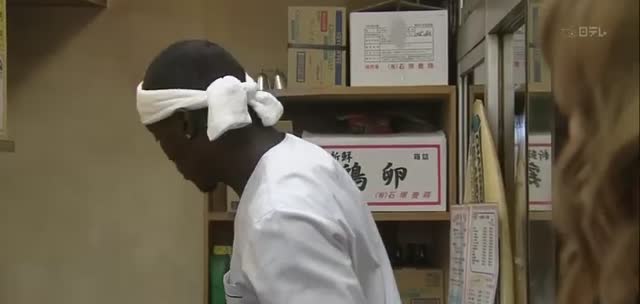
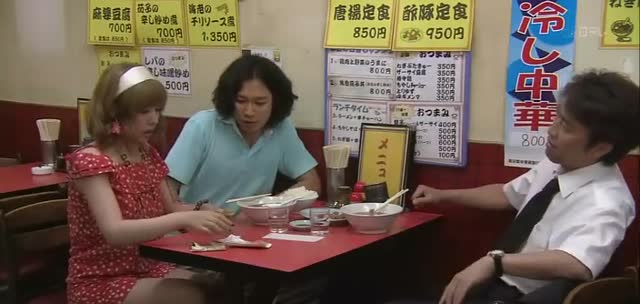
Sent off to eat by Akimoto, Haruko wanders into a ramen shop and finds Bob behind the counter greeting customers.
ボブ
いらっしゃいませ~! あ…。
Welcome~! -- Ah...
ボブ/ハルコ
いらっしゃいませ~! あ…。
Welcome~! -- Ah...
ハルコ
ラーメン1つ。
One ramen.
藤森
ラーメン 一丁! はいよ!
One ramen! -- Coming right up!
鷹栖/ハルコ・渋谷
ああっ!カリスマ! なんでここに!?
Ah! Charisma! -- Why are you here!?
鷹栖
あ~ハモるな。バカたち。
Ugh, stop talking in unison, you idiots.
鷹栖/渋谷
何してるんですか!? 何をされてるんですか。鷹栖先生。
What are you doing here!? -- What are you doing, Mr. Takasu?
Speaking notes
ラーメン 一丁
ラーメン 一丁: the order call
「一丁(いっちょう)」 is a call used in restaurants to place an order. 「ラーメン一丁!」 = "One ramen!" The cook or owner answers 「はいよ!」. This is the same 「丁」 that appeared in the tuna lesson ("one 丁 of tofu / one block of fish"), but in the restaurant it has turned into a counting unit for calling out orders.
ハモるな
ハモるな: don't speak in unison
「ハモる」 is a verb made from the music term 「ハーモニー」: two voices (or two lines) coincide. 「ハモるな」 = "Stop saying it at the same time." Takasu ends with 「バカたち」, half annoyed, half fond: "you two idiots, even your lines of surprise are the same." • 〜るな: prohibitive form (don't...).
何をされてるんですか
何をされてるんですか: される as honorific
「される」 is the honorific form of 「する」 (an honorific expression), used to raise the person doing the action. • 何してるんですか: plain (to a peer or an equal) • 何をされてるんですか: honorific (the person doing the action is a respected person) [A short lesson on keigo] The two main ways to make honorific verbs in Japanese: ① お+V+になる: お話しになる ② (ら)れる: 話される、される、来られる ③ Special verbs: いらっしゃる、なさる、召し上がる 「される」belongs to ②, a simple form often used toward superiors as "mild respect."
Takasu is carrying a pile of things, all given to him by students. Haruko casually asks whether a Japanese teacher's salary is really that low.
ハルコ
あ!それ。
Ah! That.
渋谷/鷹栖
いやいや…持ち過ぎです。 いやいや…。
No, no... you're carrying too much. -- No, no...
鷹栖
全部 生徒がくれたんだよ。
The students gave me all of it.
ハルコ
日本語教師って お給料 安いんですね?
Japanese teachers don't get paid much, do they?
鷹栖
カリスマやってた方が いいかもな。
You might be better off going back to being a charisma clerk.
Speaking notes
生徒がくれたんだよ
生徒がくれたんだよ: くれる and the receiver's viewpoint
「生徒がくれた」 = the students gave it to me (the speaker). The direction of 「くれる」 is always "someone else → me (or my side)." • あげる: me → someone else • くれる: someone else → me • もらう: I receive from someone else (the subject is me) 「全部生徒がくれたんだよ」 = the students offered it all on their own, stressing "they gave it, I didn't ask." If he had said 「全部生徒からもらった」, it would merely state where things came from.
〜方がいいかもな
〜た方がいいかもな: 'you'd better'
「〜た方がいい」 = it would be better to... 「カリスマやってた方がいいかもな」 = "Maybe you'd be better off staying a charisma clerk." 「かもな」 is the masculine form of 「かもしれないな」, a tentative "I'm not sure, but this is what you should do."